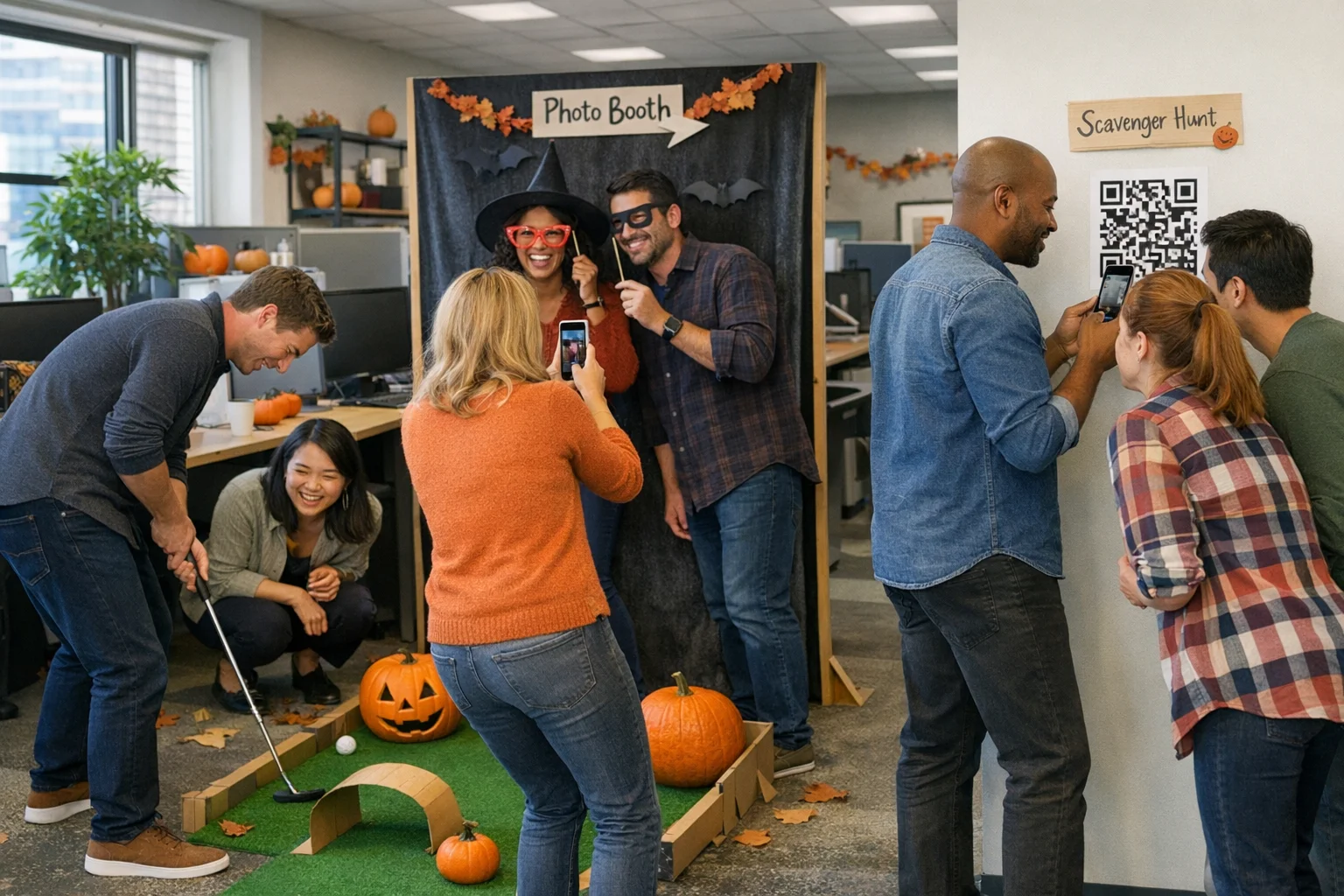
You don’t need fog machines or a haunted budget to make Halloween in the office feel alive. You need lightweight games that spark motion, micro‑collaboration, and a few shared laughs without forcing anyone to perform.
A pattern we keep seeing: the best Halloween office games are short, visual, and low‑prep. They give people reasons to mingle across teams and create quick wins you can recognize publicly. That last bit matters more than people think; consistent recognition is repeatedly tied to engagement and wellbeing in credible research. See Gallup and Workhuman’s findings on how quality recognition links to stronger engagement and retention. Gallup–Workhuman research on recognition and engagement. (gallup.com)
At a Glance
Why Halloween office games work (and how to use them well)
Most teams don’t need “big fun.” They need structured excuses to connect in short bursts. Games that move people, mix departments, and create quick visible wins raise the room’s baseline energy. Recognition is the multiplier: call out small wins publicly. It’s not just nice; it’s effective. Gallup–Workhuman research on recognition shows strong associations between meaningful recognition, engagement, and reduced turnover risk. (gallup.com)
How to run the day for real participation
- Keep rounds short. Most games land in 8–12 minutes. Rotate often.
- Pre‑seed teams. Groups of three or four beat giant clumps. Research‑informed small‑group tips. (citl.indiana.edu)
- Make it optional. Post “I’m here to spectate” stickers or lanyards so people can enjoy without pressure. SHRM’s advice is clear: opt‑in is the baseline. Halloween do’s and don’ts at work. (shrm.org)
- Name the boundary. “No gore, no stereotypes, and keep costumes work‑functional.” Simple, calm, said once at kick‑off.
- Recognize constantly. Micro‑prizes, shout‑outs, and a scoreboard that celebrates effort as much as winning keep the floor buzzing. Recognition data and outcomes. (gallup.com)
15 Halloween office games that actually land
1) Costume Catwalk with Consent Cards
Give people a low‑stakes runway moment that’s easy to join or skip. Each participant chooses a “cheer only,” “short interview,” or “photo OK” consent card.
- Why it works: Autonomy reduces pressure and lets natural hams shine.
- Setup: A simple taped runway, playlist, and three judges with fun superlatives.
- Run it: 10‑second walk per person. Judges name light superlatives like “Most Resourceful DIY,” “Best Work‑Functional,” “Funniest Backstory.”
- Variations: Remote? Post a “show your accessory in 5 seconds” round on video.
- Time: 10–15 minutes per group of 15.
- Materials: Tape, signs, index cards.
2) Haunted Scavenger Hunt (App or QR)
Short, location‑based or desk‑based tasks that send teams moving and noticing the space. Perfect for cross‑department mingling.
- Why it works: Movement plus micro‑missions equals instant energy. It also creates tons of recognition moments when you showcase completions.
- Setup: Hide QR codes or use an app to deliver photo, GPS, trivia, and riddle challenges.
- Run it: 20–30 minutes, live scoreboard, top teams featured on the big screen.
- Variations: Hybrid teams can split tasks between office and home (e.g., “find a household item that squeaks”).
- Time: 25–30 minutes.
- Materials: QR printouts or an app and a shared display.
If you want this format turnkey, Scavify makes building mixed challenge types, tracking points, and running live leaderboards fast across app and browser. It’s designed for quick launch and scale without extra staff. Naturally relevant here, just don’t overcomplicate it when a tight 20‑minute hunt will do.
Here are five Halloween‑flavored challenge prompts you can drop in immediately:
- [Photo | 30 pts]: Something orange that isn’t candy or a pumpkin.
- [Video | 50 pts]: Re‑create a classic horror scene in 5 seconds.
- [GPS Check‑in | 40 pts]: Visit the office’s quietest spot after 3 p.m.
- [QR Code | 20 pts]: Scan the code lurking near the copy machine.
- [Q&A | 30 pts]: Which team won last year’s costume vote?
3) Pumpkin Putt‑Putt
Turn the hallway into a mini‑golf lane with pumpkins as obstacles and cups as holes.
- Why it works: Fast turns, lots of laughter when balls glance off pumpkin ridges.
- Setup: Painter’s tape fairway, plastic clubs, paper‑cup holes weighted with coins.
- Run it: Three swings per player; lowest total wins. Add a “spook shot” curve.
- Variations: Remote? Kitchen‑golf with spatula and ping‑pong ball on camera.
- Time: 12 minutes per lane.
- Materials: Tape, cups, plastic clubs or improvised putters.
4) Haunted Emoji Pictionary
Teams decode spooky phrases written only in emojis on slides or cards.
- Why it works: Low barrier, high table talk. Visual thinking evens the field.
- Setup: 20 emoji phrases (e.g., ghost + bus = “spirit transport”).
- Run it: 30 seconds per clue, steal on wrong answers.
- Variations: Slack/Teams channel for remote play, points via reactions.
- Time: 10–15 minutes.
- Materials: Slide deck or printed cards.
5) Paper Mummy Wrap Sprint
Pairs wrap a volunteer in toilet paper without tearing, then pose.
- Why it works: Quick chaos, photo gold, and easy opt‑out by choosing to be the timekeeper.
- Setup: TP rolls, safe floor space, scissors for cleanup only.
- Run it: 90 seconds to wrap, 30‑second runway.
- Variations: Remote? “Wrap” a household object and reveal.
- Time: 8–10 minutes.
- Materials: Toilet paper, timer.
6) Mystery Snack Lab: Guess That Flavor
Blind‑taste small, clearly labeled, allergy‑safe items and guess flavors or spices.
- Why it works: Micro‑risk with big laughs when cinnamon turns out to be cumin.
- Setup: Pre‑portioned cups with full ingredient cards and allergen flags.
- Run it: 20 seconds per sample; reveal answers on screen.
- Safety note: Follow food‑safety basics: clean, separate, cook, chill. CDC’s food‑safety steps. (cdc.gov) For potlucks, keep cold foods cold and hot foods hot. USDA potluck guidance. (usda.gov)
- Time: 10–12 minutes.
- Materials: Labeled samples, spoons, sanitizer.
7) Monster Moves Minute‑to‑Win‑It Circuit
A quick loop of physical mini‑challenges: bat‑wing flaps (paper plates), spider push‑ups (knee taps), broom balance.
- Why it works: Short bursts of motion reset attention and mood.
- Setup: Three stations, scorecards, sanitizer.
- Run it: 45 seconds on, 15 seconds off, rotate three times.
- Variations: Remote? Camera‑on optional; self‑score honor system.
- Time: 10 minutes.
- Materials: Paper plates, broom, tape, scorecards.
8) Horror Trailer Mad Libs
Teams fill structured prompts to craft a 30‑second “trailer” and perform it.
- Why it works: Creative constraint beats awkward improv. Everyone gets a line.
- Setup: One page with blanks: villain, setting, object, twist.
- Run it: 5 minutes write, 30 seconds perform.
- Variations: Remote? Screen‑share sound effects, chat voting.
- Time: 12–15 minutes.
- Materials: Templates, timer, phone for soundboard.
9) Blackout Bingo: Spooky Edition
A 5x5 bingo card of light sightings: “witch hat,” “orange socks,” “candy trade,” “bad bat pun.”
- Why it works: Encourages gentle mingling and observation without forced talk.
- Setup: Shuffle card variants; limit to work‑appropriate items.
- Run it: 20 minutes in the background; first blackout wins.
- Variations: Remote? Replace squares with virtual sightings and chat actions.
- Time: Ongoing backdrop.
- Materials: Printed/virtual cards, pens.
10) Office Escape‑in‑a‑Box
A sequence of desk‑friendly puzzles that open envelopes or reveal QR codes.
- Why it works: Problem‑solving in small teams creates quick belonging.
- Setup: 4–6 puzzles; last code yields a prize claim.
- Run it: 15–20 minutes. Hint cards reduce frustration.
- Variations: Remote? Convert to a shared slide deck with locks.
- Time: 20 minutes.
- Materials: Envelopes, printed puzzles, lockable box or QR finale.
11) Ghost Story One‑Sentence Chain
In a circle or channel, each person adds one sentence to a growing tale.
- Why it works: Shared authorship with zero prep. The story always turns.
- Setup: Pick a starter line; set two “no‑go” themes to keep it inclusive.
- Run it: 10 minutes, fast pace; narrator reads the final cut.
- Variations: Remote? Threaded chat; read with spooky filter.
- Time: 8–10 minutes.
- Materials: None.
12) Candy Corn Stock Market
Teams start with a small stash of candy corn and trade on goofy “market news” you reveal every minute.
- Why it works: Light competition and negotiation gets strangers talking.
- Setup: Printed news cards (e.g., “Pumpkin shortage spikes prices”), trading rounds, auditors.
- Run it: 6 news cycles; most candy wins.
- Variations: Remote? Use emojis as currency in chat.
- Time: 12–15 minutes.
- Materials: Candy corn, bowls, news cards.
13) Photo Booth Storyboard
Not just photos. Teams shoot three stills that, together, tell a micro‑story.
- Why it works: Visual creativity without live performance pressure.
- Setup: Backdrop, two props, and a storyboard prompt.
- Run it: 6 minutes shoot, 1 minute show.
- Variations: Remote? Upload a three‑panel collage to the channel.
- Time: 10 minutes.
- Materials: Phone cameras, backdrop, props.
14) Haunted Trivia Gauntlet
Short, mixed‑difficulty questions about classic films, folklore, and candy stats.
- Why it works: Quick wins for different knowledge pockets.
- Setup: 20 questions across two rounds; buzzers or chat emojis.
- Run it: 15 minutes; bonus “closest without going over” tiebreakers.
- Variations: Remote? Breakout rooms for question writing between rounds.
- Time: 15–18 minutes.
- Materials: Slides, buzzer app or moderator.
15) Trick‑or‑Treat Desk Relay
Teams run a route of participating desks, completing tiny tasks to earn treats.
- Why it works: Built‑in mingling and motion. Desk hosts get to shine.
- Setup: 6–8 “stations” with micro‑tasks (tongue twister, 3‑piece puzzle). Clear opt‑out signage.
- Run it: Staggered starts to avoid hallway jams; stamp cards at each desk.
- Variations: Remote? Digital map with clickable tasks and QR “stamps.”
- Time: 15–20 minutes.
- Materials: Stamp cards, stations, treats.
Inclusion, safety, and good judgment
- Opt‑in everything. Participation and costumes are optional. Put that in writing and repeat calmly at kickoff. SHRM recommends codifying expectations and respecting that not everyone enjoys scares or costumes. Practical workplace Halloween do’s and don’ts. (shrm.org)
- No stereotypes, no gore. Spell out the boundary once. Enforce lightly but consistently.
- Accessible by design. Offer seated roles, non‑physical alternatives, and sensory‑friendly spaces.
- Food safety, always. Label allergens clearly and apply the four basics: clean, separate, cook, chill. CDC guidance. (cdc.gov) For shared dishes, follow the USDA’s potluck reminders on temperature and timing. USDA potluck tips. (usda.gov)
- Recognition beats prizes. Small, frequent shout‑outs do more for morale than one giant award at the end. The research keeps pointing the same direction. Recognition and engagement. (gallup.com)
Running hybrid and remote versions without the awkwardness
Hybrid Halloween games die in the gaps between in‑room chatter and silent tiles. Close those gaps with structure.
When a scavenger hunt is the move (and how Scavify helps)
If you want one format that scales from five desks to five floors and includes remote teammates cleanly, the scavenger hunt is it. Photo moments, QR reveals, and quick trivia keep momentum high, and you get an automatic highlight reel.
Scavify shows up naturally here because you can:
- Mix challenge types (photo, video, GPS check‑ins, QR, Q&A, multiple choice) without juggling apps.
- Automate scoring and run live leaderboards so recognition happens in real time.
- Launch fast in browser or app, with flexible scale for one office or many.
Keep the run tight, make completions public on a shared screen, and end while the room is still laughing. That’s the move.
FAQs
What are the easiest Halloween office games to run with almost no prep?
Blackout Bingo, Haunted Emoji Pictionary, and Ghost Story One‑Sentence Chain are reliably fast. Print or share a single page, explain in 30 seconds, and you’re rolling.
How long should a Halloween games block be during the workday?
Aim for 45–75 minutes with short rounds and quick resets. That’s enough time to warm up, peak, and end without energy sagging. If you want more, split into two blocks separated by real work time.
How do we include people who don’t want to dress up?
Make costumes optional and design non‑costume games (trivia, emoji, escape‑in‑a‑box). Offer consent cards for photos and interviews so people can control visibility. SHRM recommends opt‑in across Halloween activities. Workplace Halloween do’s and don’ts. (shrm.org)
What about food allergies and potlucks?
Label every ingredient, provide utensils for each dish, and keep hot foods hot and cold foods cold. Follow the CDC’s four steps to prevent foodborne illness and the USDA’s potluck guidance on temperatures and timing. CDC basics and USDA tips. (cdc.gov)
We’re fully remote. What actually works without awkward silences?
Time‑boxed scavenger tasks, emoji pictionary, micro‑trivia, and storyboard photo posts. Keep groups to three, give clear written prompts, and use broadcast messages so no one misses instructions. Small‑group best practices and breakout room host tips. (citl.indiana.edu)
How do we keep things professional without killing the fun?
Set two or three bright‑line rules (“no gore, no stereotypes, keep costumes work‑functional”), make participation optional, and focus on games that celebrate creativity and teamwork instead of shock value.
Do prizes matter, or are shout‑outs enough?
Shout‑outs carry more weight than most people expect, especially when they’re specific and timely. Add a few small prizes for variety, but keep recognition frequent and public. Research on recognition and engagement. (gallup.com)
What’s a simple run‑of‑show we can copy?
- Kickoff and boundaries: 2 minutes.
- Quick warm‑up game: 8 minutes.
- Main rotation (3 games): 30–40 minutes total.
- Scavenger mini‑finale or trivia: 10–12 minutes.
- Rapid awards and thank‑yous: 3 minutes.
End while the room is still buzzing. Leave them wanting the next one.