Solutions
Your first hunt, live this afternoon.
Free to start · No download for participants
Explore gamification in lms through useful examples, proven mechanics, implementation steps, measurement ideas, and pitfalls to avoid. Choose confidently.
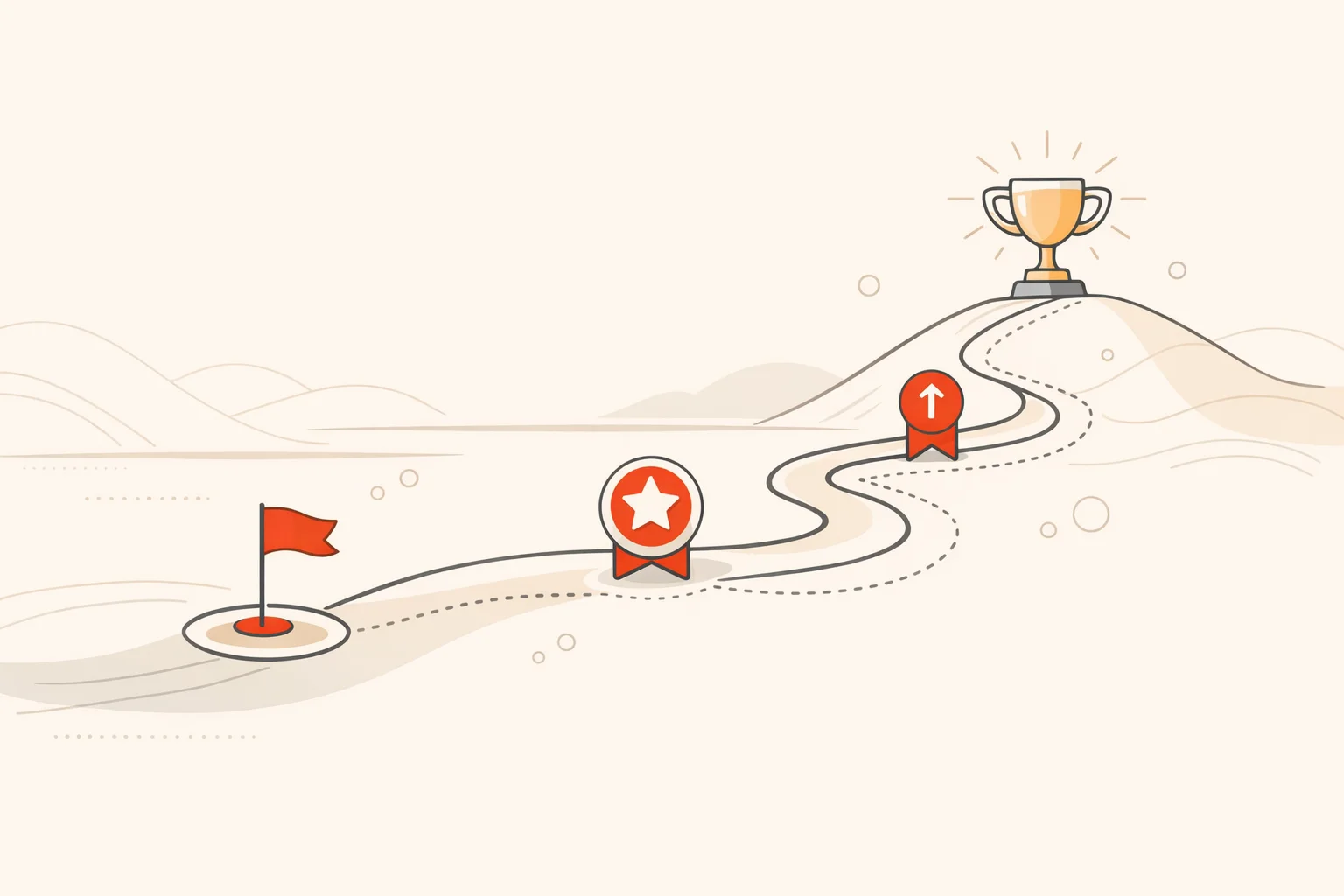
If you’ve ever watched a cleanly designed course stall at 38 percent completion, you’ve felt the limits of content alone. Modern LMS platforms can deliver information. They don’t always create the momentum to start, continue, and apply it. That’s where gamification shines when it’s treated as behavior design, not window dressing.
This guide cuts through the tropes. We’ll define what effective gamification in an LMS looks like, show the mechanics that consistently work, outline an implementation playbook, and map the metrics that prove it. You’ll also see the traps that quietly sink good intentions.
Think of gamification as selectively adding game design elements to a non-game flow to change real behavior: starting modules, finishing them, and applying what was learned. In education and training, two large syntheses report overall positive, often moderate effects when elements are aligned to context and pedagogy, not bolted on. See the Educational Psychology Review meta-analysis by Sailer and Homner and a 2023 Frontiers in Psychology meta-analysis for the nuance by element and setting. Educational Psychology Review meta-analysis; Frontiers in Psychology synthesis. (doi.org)
The motivation model under most successful designs is Self-Determination Theory: support for autonomy (choices), competence (clear progress), and relatedness (belonging). When mechanics strengthen these needs, engagement tends to follow; when they crowd them out, it fades. For a plain-English anchor, see the APA’s overview of Self-Determination Theory. APA overview of SDT. (apa.org)
We see strongest lift in flows with frequent, observable behaviors: microlearning, practice quizzes, software walkthroughs, field exercises, and scenario branching. These give you repeated chances to reward progress, surface feedback, and build confidence.
Backfires tend to show up when points become the point. Over-reliance on public rank-order leaderboards or purely extrinsic rewards can nudge some learners, but it often undermines intrinsic motivation, particularly over time or for lower-ranked participants. Evidence is mixed by design, but the caution is real in longitudinal classroom studies and element-level experiments. Hanus & Fox (2015) classroom study; Mekler et al. (2017) element-level study. (doi.org)
Effective LMS gamification is less about stacking widgets and more about tidy feedback loops.
Use this sequence when you’re building inside an LMS or pairing it with an engagement platform.
Motivation follows momentum. Make the first minute a guaranteed win.
Between steps three and six is where most of the lift happens. You’ll feel it in completion curves and how often learners voluntarily re-attempt for mastery rather than minimums.
Measurement starts with a simple question: what counts as learning here? Choose metrics that fit.
If you want an evidence base for expecting lift, the meta-analyses mentioned earlier report positive effects on cognitive, motivational, and behavioral outcomes when designs align with pedagogy and context rather than relying on “points-only” overlays. Educational Psychology Review meta-analysis; Frontiers in Psychology synthesis. (doi.org)
A pattern we keep seeing: short, concrete challenges outperform abstract “watch and acknowledge” tasks. Below are patterns that land in work and academic settings.
When you want variety or mobile-first interactions, pairing your LMS with a flexible challenge platform helps. Even a simple scavenger hunt app format can turn dry checklists into playful quests for onboarding, orientation, and field training.
Most modern LMSs include points, badges, quizzes, and basic progress visualizations. That can be enough for course-only goals. If you need flexible, real-world tasks, mobile capture, location validation, or live events, an engagement layer on top gives you more mechanics and faster iteration.
| Consideration | LMS built-ins | Dedicated engagement layer |
|---|---|---|
| Challenge variety | Quiz-heavy; limited activity types | Photo, video, QR, GPS, trivia, team play |
| Mobile-first experiences | Often secondary | Designed for field use |
| Real-time feedback & live ops | Limited | Strong controls and automation |
| Offline tolerance | Varies | Common |
| Cross-environment use (events, campus, field) | Course-centric | Broad contexts |
If you want a deeper research lens on when mechanics help or hurt, start with element-level work that probes how points, badges, and leaderboards interact with motivation; results highlight why context and design matter. Mekler et al. on element effects; a cautionary classroom example appears in Hanus & Fox (2015). (sciencedirect.com)
Gamification adds selected game elements to ordinary learning flows to nudge behavior and improve outcomes. Game-based learning builds a full game to teach something. Both can work; gamification is usually faster to ship inside existing courses.
Short mastery challenges, visible progress, and rapid corrective feedback travel well across contexts. Corporate rollouts often add QR or GPS tasks for field validation; higher ed frequently favors quizzes, scenario branches, and peer recognition.
Not categorically. Use time-bounded sprints, opt-in visibility, or relative leaderboards instead of permanent global ranks. Prioritize personal bests and mastery markers.
Track quality (first-pass accuracy, no-hint solves), persistence (retries after feedback), and application (on-the-job signals or post-course performance). Compare cohorts before and after changes.
Design for autonomy, competence, and relatedness. Give choices, make progress visible, and recognize meaningful behaviors. This is the practical application of Self-Determination Theory. SDT overview. (apa.org)
Usually. Start with badges, progress visuals, and short scenario checkpoints. If you need mobile capture, location validation, or event activation, pair your LMS with an engagement layer that supports richer challenges.
You’ll often see a start-rate and retry-rate bump within the first cycle if loops are short and feedback is tight. Skill-quality and application indicators typically follow as you iterate.
Well-designed interactive experiences change behavior you can measure. Treat gamification in your LMS as behavior design with fast loops and meaningful recognition, and it will do what content alone often can’t: keep people moving, learning, and applying.