Solutions
Your first hunt, live this afternoon.
Free to start · No download for participants
Explore gamification engagement through useful examples, proven mechanics, implementation steps, measurement ideas, and pitfalls to avoid. Choose confidently.
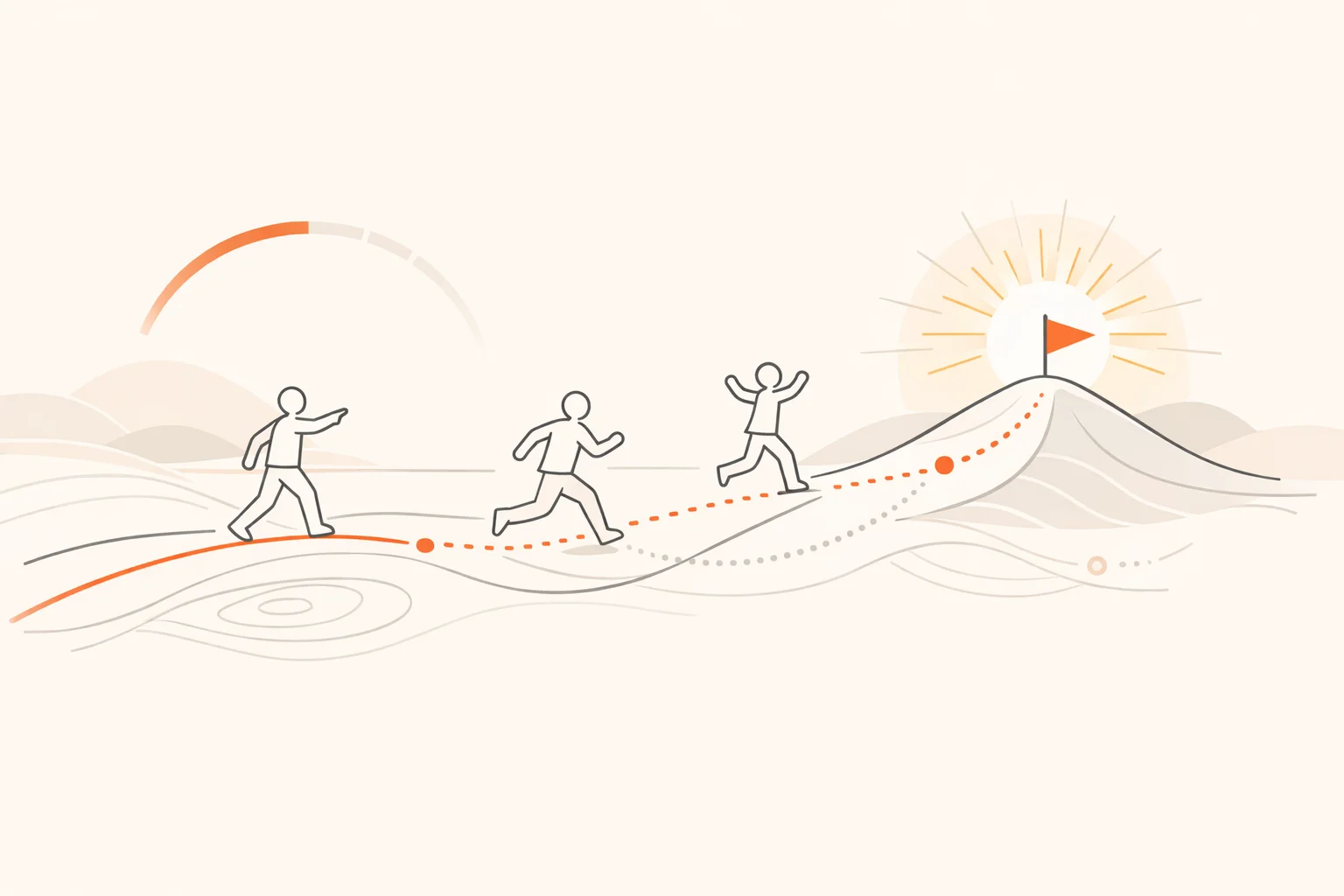
Most teams don’t need more features. They need more participation. That is the quiet promise of gamification: not fireworks, but a steady nudge that turns passive audiences into active ones. The question is whether it actually works, and under what conditions it holds up outside the lab.
Short answer: yes, gamification can increase engagement. The longer answer is more useful. Effects are real but uneven. Context, design quality, and measurement decide whether you get a short sugar rush or durable behavior change.
Attention is fragmented. Budgets are watched closely. Leaders want proof that participation wasn’t just “fun,” it moved a number that matters. Gamification is attractive because it seems to promise more activity without massive content production. But it only performs when tied to clear outcomes and measured like any other program.
“Engagement” is vague until you pin it to behaviors and metrics. A useful frame is Google’s HEART model: Happiness, Engagement, Adoption, Retention, and Task success, originally published as a way to map product goals to user‑centered metrics. See the original description of the HEART framework for examples of how to translate fuzzy intent into trackable signals.
For live programs and activations, we typically operationalize engagement as some combination of:
The research base is broad and messy, but patterns are consistent:
Learning and training. A comprehensive meta‑analysis found gamification shows positive effects on motivation and learning outcomes when mechanics are thoughtfully aligned to the task, with effect sizes that are meaningful but not magical. Read Sailer and Homner’s meta‑analysis on gamification and learning for the summary of what tends to work and why.
Digital program adherence. In health and online programs, a systematic review concluded gamification can increase engagement and downstream outcomes, while cautioning that many studies underreport which mechanics they used. See JMIR’s review, Does gamification increase engagement with online programs?
Mental health and wellbeing apps. Reviews find associations between gamified features and adherence, but stress the importance of design details and context. See gamification and adherence to web‑based mental health interventions for nuance.
Physical activity and behavior change. Reviews in this domain mirror the above: benefits are common, design quality matters, and social and feedback loops are often the active ingredients. A representative summary is Koivisto & Hamari’s overview of gamification of physical activity comparison studies.
Caveats on common mechanics. Points, levels, and leaderboards can boost short‑term activity but don’t guarantee intrinsic motivation. See Mekler et al.’s analysis on whether these mechanics harm or help intrinsic drive, Do points, levels and leaderboards harm intrinsic motivation? Leaderboard effects, specifically, are mixed; one large field study questioned whether leaderboards are general performance enhancers at all, documenting inconsistent gains across conditions.
A pattern we keep seeing: when mechanics support basic psychological needs, engagement lasts. When they undermine them, it fades fast. That line runs straight through decades of Self‑Determination Theory research.
Design for autonomy, competence, and relatedness. The rest is ornament.
Works best when:
Underperforms when:
If you like named frameworks, Yu‑kai Chou’s Octalysis is a practical lens for mapping mechanics to motivations. See a concise overview via the official Octalysis Framework page.
1) Define the goal behavior. One sentence, one verb. “Complete 4 onboarding modules by week two.” “Visit 6 learning booths before noon.”
2) Choose engagement metrics. Map to HEART: which signals prove you’re on track? For example, Active depth (avg. challenges completed), Retention (day‑7 return), Task success (pre/post check gains). Use the HEART framework as your template.
3) Draft your challenge mix. Aim for variety: quick skill checks, creative captures, location check‑ins, timed boosts. Keep any single challenge to a few minutes.
4) Decide your social layer. Solo with light visibility, peer teams, or cross‑function squads. If you use a leaderboard, show tiers and personal bests, not just the unreachable top.
5) Prototype the first session. Run a 20‑minute pilot with a handful of users. Watch where energy dips. Adjust pacing and clarity, not just rewards.
6) Instrument everything from day one. Log starts, completions, abandon points, and dwell times. Without instrumentation, you’re guessing.
7) Ship, then tune. Expect to adjust difficulty and add micro‑rewards or streak savers mid‑run. Treat it like a product, not a poster.
For context on what tends to move learning outcomes versus just clicks, cross‑reference Sailer and Homner’s evidence synthesis and JMIR’s systematic review on online engagement.
Employee onboarding and training. Quests guide week‑one tasks, short quizzes confirm mastery, and streaks keep momentum through week two. Reviews across health and education consistently show motivation and participation gains when mechanics map to clear tasks; see the systematic review of gamification in health professions education for patterns that translate well to corporate learning.
Conferences and trade shows. GPS or QR check‑ins at booths, time‑boxed bonus windows to fight the post‑lunch slump, and a live feed that turns audiences into co‑marketers.
Campus orientation. Team missions to essential services, photo challenges to build affinity, and trivia that quietly transfers “need‑to‑know” policies.
Tourism and city activations. Location‑based quests that turn a walk into a story and visitor UGC into a discovery engine.
Note: Scavify runs these activations at scale with a mix of challenge variety, automation, and play‑anywhere flexibility (mobile browser or native app). If you’re standing up a fast activation, that combination removes a lot of operational friction.
If you prefer to run these as a lightweight experience with sign‑ups, live leaderboards, and approvals out of the box, a purpose‑built scavenger hunt app keeps setup fast and participation high.
| Approach | Experience‑led design | Points‑first design |
|---|---|---|
| Goal clarity | Behavior tied to outcomes | Activity for activity’s sake |
| Challenge variety | Creative, location, knowledge, timed | Mostly clicks and trivia |
| Social layer | Teams, tiers, visibility without shame | Single top‑10 leaderboard |
| Feedback | Immediate, meaningful | Delayed or opaque |
| Staying power | Weeks | Days |
Does gamification really increase engagement?
Yes, with caveats. Multiple reviews and meta‑analyses show positive effects on motivation, adherence, and sometimes learning outcomes when design supports autonomy, competence, and relatedness. See the education meta‑analysis and JMIR’s online engagement review for representative evidence.
What mechanics should I start with?
Start with clear goals, progress indicators, immediate feedback, and a mix of challenge types. Add social visibility and recognition tiers once the basics hum.
Are leaderboards good or bad?
Both. They energize some, discourage others. Prefer team tiers and personal bests over a single top‑10. Large‑scale studies show leaderboard effects are inconsistent; see field data on mixed impacts.
How do I avoid rewarding only speed?
Score accuracy and creativity, require verifier approval for big points, and use time‑boxed boosts sparingly. Activity without quality is noise.
How should I measure success?
Instrument day‑one metrics (starts, early streaks), depth (actions per user), and outcome proxies (quiz accuracy, booth meetings). Map them to HEART to keep your metrics honest using Google’s original guide.
Will rewards kill intrinsic motivation?
Poorly applied rewards can. Use them as feedback and celebration, not as bribes. For nuance on PBL elements and intrinsic drive, see Mekler et al.
What about health and education contexts?
Evidence is generally positive on adherence and satisfaction, with mixed results on long‑term learning without good feedback design. See gamification in health professions education systematic review and mental health adherence review.
Which design framework should I use?
Pick the one your team will actually use. Octalysis is approachable and maps well to real motivations. The official framework overview is a solid starting point.
Gamification increases engagement when it makes the work feel winnable, visible, and worth doing. Treat it as experience design grounded in human motivation and measured with product‑grade rigor. Do that, and you’ll see participation shift from “should” to “want to” — which is the only kind that lasts.