
Solutions
Your first hunt, live this afternoon.
Free to start · No download for participants
Explore trade show booth games with standout examples, selection guidance, setup steps, mistakes to avoid, and ideas you can adapt quickly. Choose confidently.
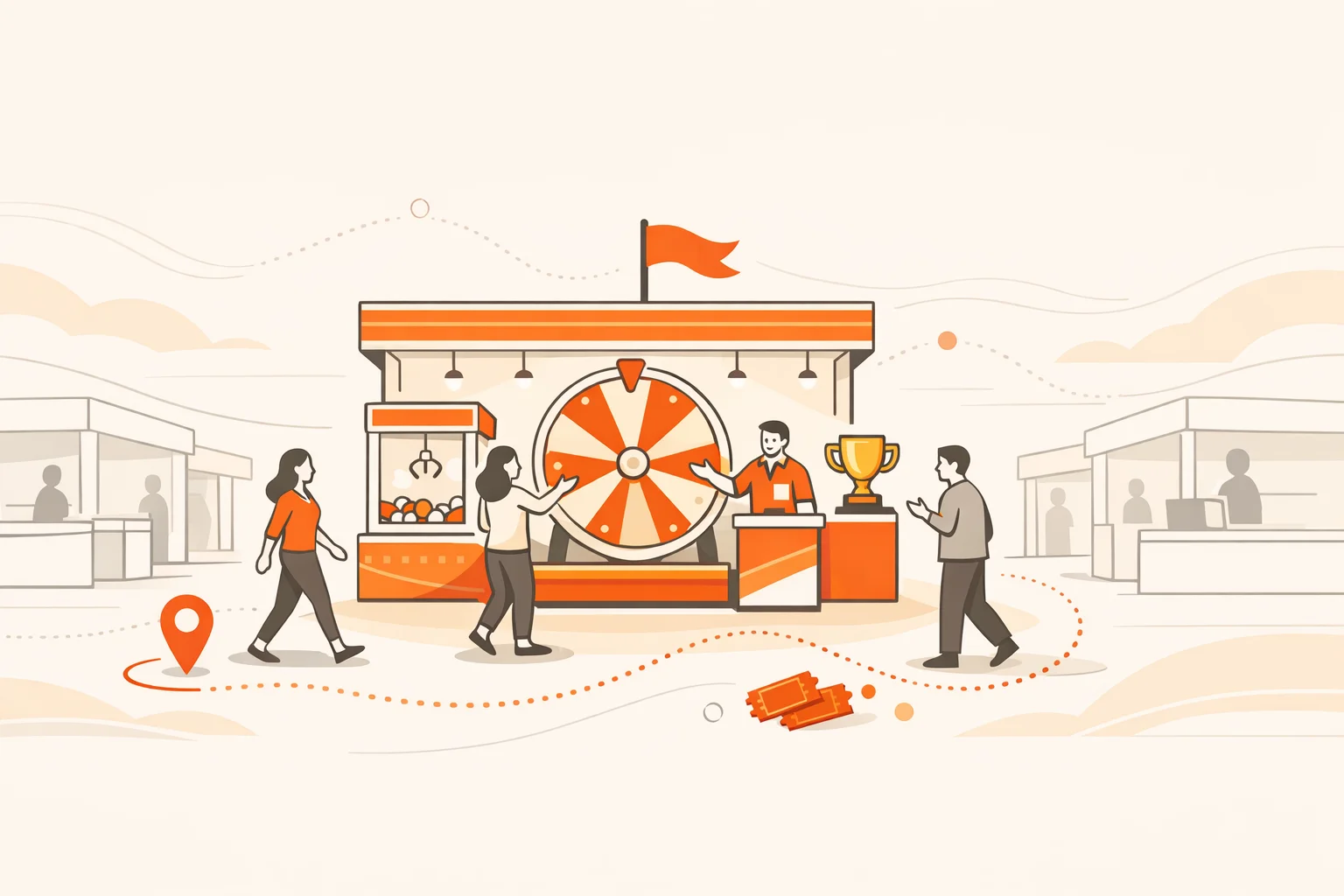
Trade show floors are noisy with motion, light, and promise. Most booths are attractive enough, a few are spectacular, and a handful are impossible to ignore. The difference usually isn’t the booth size. It’s the experience in front of it.
Booth games aren’t party tricks. Done well, they create a reason to stop, a reason to stay, and a reason to talk. That’s the funnel on a show floor: stop rate, dwell time, qualified conversations. The right game pulls all three in the direction you need.
A pattern we keep seeing: simple mechanics, fast turns, clear stakes, and an easy on-ramp for shy humans beat theatrical gadgets that make the line stall. If it helps people learn one thing about your product while they play, even better.
Most teams try to do everything at once and end up with a line that doesn’t convert. Start by choosing a primary outcome:
Tie the outcome to a mechanic:
In our experience, gamification works best when it mirrors behavioral science basics: clear goals, immediate feedback, optional competition, and visible progress. That’s consistent with findings summarized in Harvard Business Review’s discussion of gamified learning outcomes and more recent analysis on engagement mechanics. (hbr.org)
| What you get | App-based scavenger challenges | Classic carnival games |
|---|---|---|
| Lead capture happens before prizes | Built-in with QR sign-in and prompts | Often manual or forgotten |
| Education about your product | Trivia, reveals, and micro-demos | Entertainment only |
| Throughput during peak traffic | High with 30–90 second turns | Variable and line-prone |
| Data quality for follow-up | Structured notes and qualifiers | Loose business cards |
| Social amplification | Photo and video moments by default | Depends on props and luck |
Nobody quits a game they are winning. Make the first turn a guaranteed win.
Each idea includes what it’s good for, how it works fast, and an easy lead capture move. Mix two or three so no single skill decides the whole experience.
A simple sprint. Attendees scan a QR, answer three product trivia questions, and watch their name pop onto a live leaderboard. Great for top-of-funnel and education in one pass.
Lead capture: QR gate collects name, role, and one qualifier. Prize draws every hour for the top 5 scores.
Replace random prizes with segments labeled by product benefits. Land on a segment, get a 15 second demo on that benefit, then pull an envelope for a prize.
Lead capture: hand the envelope only after a quick badge scan.
A magnetic or digital jigsaw of your product workflow with one piece missing. Solve it and a rep completes the last piece with a one-line insight.
Lead capture: unlock a larger prize when they scan and beat a time threshold.
Point a phone at a physical product to reveal overlays that answer “what’s inside,” “how it scales,” or “before and after.” Keep each reveal under 10 seconds.
Lead capture: on-screen CTA to save the AR card to email.
Give people gloves and a 30 second task that simulates a user constraint. If you sell safety, precision, or robotics, this lands.
Lead capture: quick tap form to text a results link and a one-question qualifier.
Two tablets. 10 rapid-fire questions tied to your buyer’s world. Crowd watches the race and cheers the last-second comeback.
Lead capture: gate the final “claim your victory” screen behind a scan.
Hide a single riddle in your signage. Solve it to unlock a code that opens a prize box. Keep it solvable in under a minute.
Lead capture: QR sticker on the box to submit the code and contact details.
Flip 12 tiles to find 6 pairs that correspond to your features. Each match triggers a one-line explanation on-screen.
Lead capture: auto email the results card when they opt in at start.
Each slot maps to a benefit path. Wherever the puck lands, your staff gives the 20 second version instead of a random tidbit.
Lead capture: snap a quick photo and text it to them with a follow-up link.
Create a clean, on-brand scene people want on their feed. Tie it to a prompt like “Show us the face you make when X becomes easy.”
Lead capture: QR to a gallery where they retrieve their photo by email.
15 seconds. A light, a mic, and a prompter with a fun line tied to your message. Cut the clip on the spot.
Lead capture: deliver the clip by text. Post the best to your screen with permission.
Attendees draw a sketch of the problem you solve, then share it to a rolling feed. It becomes a visual wall of pains you address.
Lead capture: opt in to get a timelapse of their art.
Hands go through opaque sleeves to manipulate your product or a proxy. People nearby try to guess what’s happening.
Lead capture: ask one qualifying question before they reach in.
Use floor lights or tape to route a mini obstacle line, timed with a visible countdown. Cheesy becomes charming when it runs fast.
Lead capture: capture at the timer start in exchange for a scorecard.
Teach a tiny, useful task on repeat, like a keyboard shortcut that saves time or a 2 step method most pros don’t know.
Lead capture: email the tutorial card when they scan.
Put a cost or time stat from your product into a guess-the-number reveal. Closest wins at the top of each hour.
Lead capture: collect guesses by QR with name and role.
Three sliders on a screen: what’s your current time to X, error rate, or conversion. Show how they stack against anonymized benchmarks.
Lead capture: deliver their personalized benchmark as a PDF.
A tiny indoor drone through a two-gate course. Keep it safe, short, and supervised. People love motion.
Lead capture: entry list built from opt-in waiver.
Each capsule contains a question card. Draw one, answer it, then a rep matches you to a prize based on your context.
Lead capture: scan to release the claw and to record the answer.
Spin to land on a common objection. Your rep has 20 seconds to handle it clean. The crowd judges with simple paddles.
Lead capture: invite judges to a daily grand prize after a quick scan.
A 90 second whiteboard sprint: you describe your challenge, a specialist sketches a path. This consistently pulls serious buyers.
Lead capture: text a photo of the sketch with the expert’s contact card.
Place three small AR markers around your space. Each reveals a clue that teaches. Finishers unlock a bonus draw.
Lead capture: quick sign-in at the first marker.
Mark six dots on the floor. People rotate every 45 seconds to answer a good question. Great in association pavilions.
Lead capture: QR check-in creates a contact sheet for participants.
Use body tracking for a simple on-screen dodge or collect mechanic branded with your theme. Keep rounds under 30 seconds.
Lead capture: auto prompt on-screen when they finish.
Blocks labeled with topics. Pull one, you get a 15 second nugget and a follow-up question that opens a real conversation.
Lead capture: scan to log their chosen topic for follow-up.
Small branded stickers around the booth tell a mini story when found in order. Works best in large footprints.
Lead capture: submit a quick proof photo via QR to claim a prize.
A 4 digit lock on a box. The code is the answer to a product riddle printed in plain sight.
Lead capture: capture name and email to get a hint if they need it.
Loop a before clip on screen. Attendees guess the after. Reveal the real result with a one line metric.
Lead capture: collect guesses via QR and announce winners at set times.
Old school buttons with new school content. Press to reveal a tip, a myth, or a fast fact, then answer a single question.
Lead capture: gate the final scoreboard behind a badge scan.
Rings map to segments with questions. Land a ring, answer the segment’s question to score.
Lead capture: enter the bracket by scanning first.
A large printed map where people mark where they struggle most. Patterns become conversation starters.
Lead capture: QR to receive the aggregated insights after the show.
Give pairs the same small kit that mirrors your product idea. Fastest clean build wins. Staff narrates the key step.
Lead capture: register to compete and to get a how-we-built-this PDF.
A physical buzzer triggers the next question on-screen. Noise draws a crowd if you keep it tasteful.
Lead capture: scan to join the buzzer queue.
A single-screen simulation that shows your value prop under pressure. Speed-run style.
Lead capture: email the run summary and a next-step CTA.
Every time someone plays any game, the jackpot increases by a tiny amount. Announce the winner at day’s end. The crowd shows up for the countdown.
Lead capture: all entries from earlier games roll into this draw.
If a hunt format fits your show, mix challenge types so everyone gets a win in the first minute. Scavify supports browser play or app play, which makes it easy to launch fast. If you’re exploring tools, a modern scavenger hunt app keeps setup and scoring tight.
Prizes should accelerate the game’s goal, not replace it. Useful rules of thumb: small instant wins keep the line moving, scheduled bigger wins create peaks, and one meaningful grand prize keeps serious prospects returning.
What usually shifts the dynamic is making the prize path transparent. Post exactly when drawings happen, how to qualify, and what changes if you beat a time or score threshold. Transparency cools down line anxiety and arguments.
Consider quality experiences over swag. Research roundups like Cvent’s experiential marketing statistics point to continued investment in in-person experiences because they create memories that travel further than trinkets. (cvent.com)
You need more than badge scans. Use three layers of signal:
On the tooling side, lead retrieval scanners grab contact basics, and modern systems let you structure notes at capture time. If your organizer supports it, mix in QR based forms and your own capture path so you aren’t beholden to a single device. Basic definitions of lead retrieval, including common approaches like badge scanning, are well covered in neutral sources and vendor docs. (en.wikipedia.org)
For social amplification, schedule two photo moments daily and give people their media fast. A steady feed of attendee created content beats a few polished posts no one shares.
The continued spend on live experiences and the effectiveness of well designed game mechanics show up across industry research and practice. Event industry surveys in 2025 and 2026 highlight experiential as a durable channel for attention and trust, while engagement science continues to validate simple game elements that drive behavior when used with care. Pointers include BizBash’s 2025 trends snapshot, Cvent’s report on marketer sentiment toward events, and CEIR’s long running focus on attendee floor engagement. (bizbash.com)
What’s the ideal game length for a busy show floor
Aim for 30–90 seconds. That’s enough time to feel like a real win without backing up the lane.
How do we avoid prize hunters who never convert
Make the best prizes conditional on answering one useful qualifier or attending a short micro demo. Keep instant wins modest.
How many games should we run at once
Two is the sweet spot for most footprints. One edge game for stops, one inside game for conversations.
What metrics should we review in the daily huddle
Stops per hour, average dwell time, qualified conversations, and follow-ups scheduled. Adjust roles or mechanics based on these.
Are high tech games worth the logistics
They can be if they’re fast and visible. But a crisp analog game with smart narration often outperforms a laggy screen.
How do we capture leads without slowing things down
Gate prizes behind a quick scan and 2–3 tap qualifiers. Keep keyboards out of the aisle.
What if our product is complex
Use the game to reveal one concept. The depth belongs in a conversation right after the win, not inside the turn itself.
Can we make this work with a small team
Yes. Pick one high throughput mechanic, pre-stage prizes, and keep rules obvious from five feet away.
If you build around human attention first and prize mechanics second, your booth becomes a place people plan to visit, not just a spot they stumble into. That shift is the actual win.

