Solutions
Your first hunt, live this afternoon.
Free to start · No download for participants
Learn how gamification works with clear examples, practical use cases, and tips for education, work, and engagement.
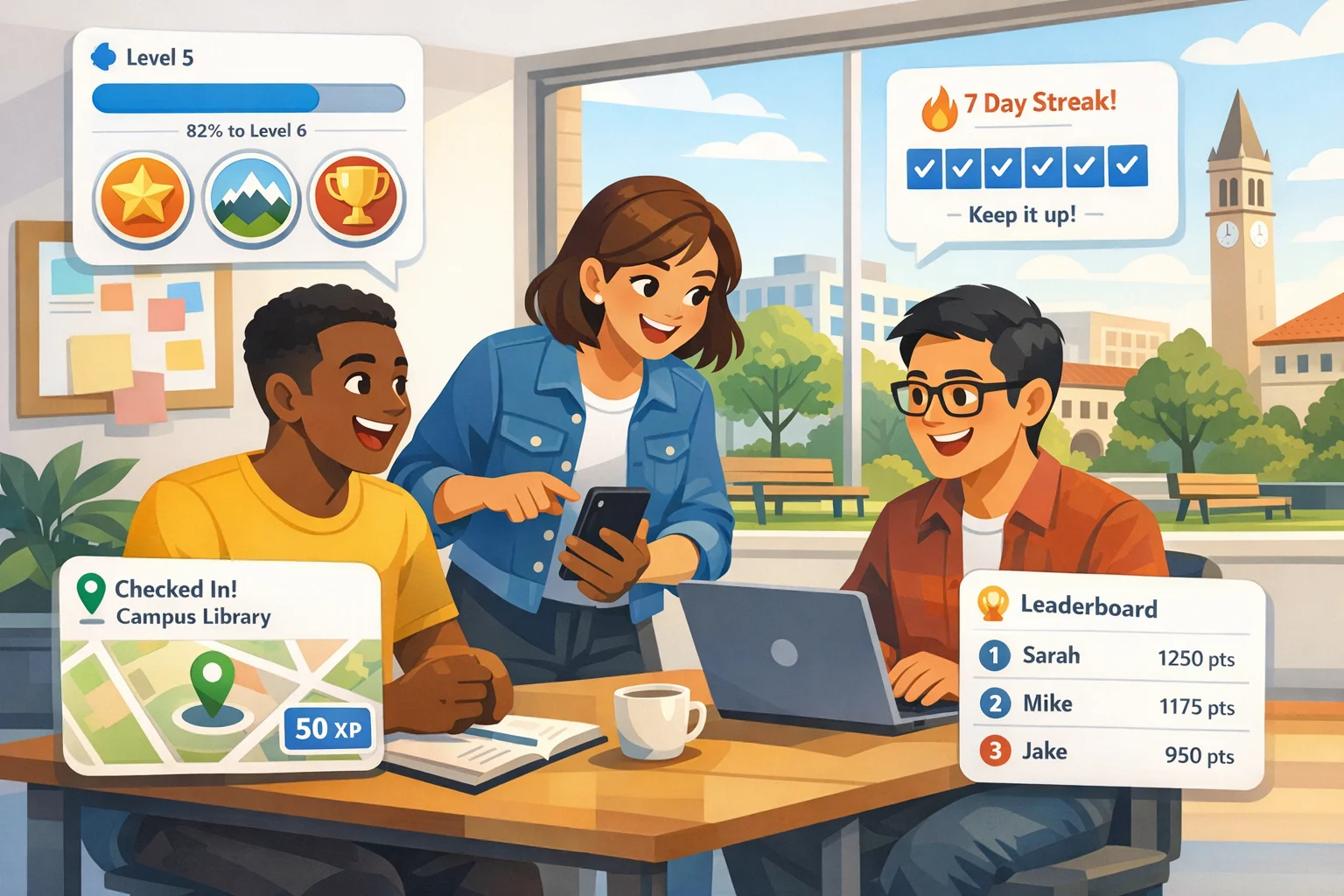
If you strip the buzzwords, gamification technology is any system that uses game design to reliably change real-world behavior. The best versions don’t feel like games. They feel like momentum.
This guide explains how to design, evaluate, and buy gamification technology that actually works. It is written for two groups who often sit across the same table: builders designing products and buyers responsible for outcomes.
At its core, gamification technology is a behavior change system. It applies proven game design patterns to non-game contexts such as skills training, onboarding, campus orientation, team building, tourism activations, and brand experiences.
Two clarifications keep teams out of trouble: - Gamification is not a video game. It is a structured set of feedback loops layered onto an existing journey. - It is not decoration. If adding points and a leaderboard is the plan, the plan will underperform. That’s not cynicism. It’s pattern recognition and a lesson echoed in the research synthesis in Hamari, Koivisto, and Sarsa’s literature review and subsequent work.
Designing without a psychological backbone is the fastest road to novelty that fades. Three bodies of research guide durable systems:
Self-Determination Theory (SDT). People stick with tasks when experiences satisfy three basic needs: autonomy, competence, and relatedness. Any mechanic that blocks these will feel forced. A concise, practitioner-friendly overview lives on the official Self-Determination Theory site.
Fogg Behavior Model (FBM). Behavior happens when motivation, ability, and a prompt converge at the same moment. Make the target action simpler, raise motivation with meaningful progress, and time prompts precisely. BJ Fogg’s model is summarized clearly on the official Behavior Model site and the Behavioral Scientist explainer.
Meta-analytic evidence. Gamification can improve cognitive, motivational, and behavioral learning outcomes when designed with care, but effects depend on context and elements used. See Sailer & Homner’s meta-analysis and a healthcare/online-programs review on engagement from JMIR/NIH’s open repository.
In our experience, the SDT and FBM trio translates into three design questions: - Where does the user choose? Increase autonomy through optional paths, flexible pacing, and meaningful choices. - Where do they feel progress? Scaffold competence with immediate feedback, visible progression, and level-appropriate challenges. - Where do they feel connected? Add light social proof, peer recognition, and cooperative goals.
Think in layers, not features.
A practical stack for most organizations looks like this: - Experience layer: Mobile app and browser experience with offline tolerance and real-time feedback. - Orchestration: Rules engine to schedule prompts, rotate challenges, segment audiences, and trigger automations. - Content tools: Challenge templates for photo/video, GPS check-in, QR scan, multiple-choice, and Q&A. - Data/identity: SSO, role-based access, audit logs, and a clean events schema feeding your BI tool. - Integrations: LMS/LXP, CRM/marketing automation, HRIS, and collaboration tools.
Scavify lives in the experience and orchestration layers for team building, orientation, conferences, and tourism activations, with challenge variety and automation that make high-participation programs faster to launch at any scale.
Patterns we keep seeing:
Onboarding and training. Short, level-gated tasks with immediate feedback build early competence and momentum. Collaborative missions keep relatedness high.
Employee engagement and team building. Missions tied to real work, peer recognition, and time-bounded sprints outperform generic points-for-everything.
Campus orientation and conferences. GPS check-ins, session quests, and exhibitor challenges convert passive attendance into active exploration. Social mechanics work best when lightly competitive and mostly collaborative.
Tourism and brand activations. Location-based hunts, creative challenges, and earned status create memorable, shareable touchpoints that generate useful UGC.
Learning and habit formation. Streaks and daily prompts can be powerful when paired with grace policies that preserve autonomy. Duolingo publicly reports that reaching a 7-day streak significantly lifts next-day return probability, with an internal analysis noting learners who hit 7 days are 2.4 times more likely to return the next day than learners without a streak. See their write-up on improving the streak for concrete product decisions and measured impact, and additional detail on how the streak builds habit.
Skip the 18-month platform boil. Do this instead:
1) Define one behavioral outcome. Example: “New hires complete 5 scenario-based modules in week one.”
2) Map the behavior model. What will raise motivation, simplify the action, and time the prompt? Document the answers.
3) Prototype the core loop. One onboarding quest, five level-appropriate challenges, immediate feedback, and a visible progress bar. Keep the first version deliberately small.
4) Instrument from day one. Track activation, daily active ratio, challenge completion, streak adherence, time-to-first-success, and cohort retention.
5) Pilot with two segments. Example: one department and one location. Hold something back to serve as a comparative baseline.
6) Run short experiments. Adjust difficulty, prompt timing, and social features. Look for statistically credible lifts, not big numbers.
7) Codify what works. Turn winning patterns into templates and automations. Then scale.
Measure behavior change and business outcomes together.
For learning contexts, meta-analytic evidence shows moderated positive effects when mechanics are selected and combined thoughtfully. The synthesis from Sailer & Homner is a useful benchmark, and the JMIR review on engagement in online programs helps separate hype from measurable participation.
Build when: - Gamification is core IP in your product and the loop differentiates you. - You have engineering and design capacity for rules engines, analytics pipelines, and scalable content tools. - You need deep custom integrations or offline/edge behaviors beyond standard SDKs.
Buy when: - Time-to-value matters and you need a reliable playbook now. - Your use case is episodic or program-based (events, onboarding cohorts, activations) where repeatable templates win. - You need orchestration and analytics more than bespoke game logic.
Hybrid is common: use a platform for orchestration and UX, then extend with your data and content.
Look past feature lists. Ask for sandboxes and watch the system in motion.
A pattern we keep seeing: strong kickoff, quiet month three. Here’s what usually breaks.
PBL tunnel vision. Points, badges, and leaderboards are tools, not strategy. They can backfire when they crowd out autonomy or create runaway status gaps. Research highlights that combinations matter more than any single mechanic and that overemphasis on competition can be suboptimal. See the effect moderators summarized in Sailer & Homner.
No prompt discipline. Notifications sent at the wrong time decay trust. Use FBM logic and test timing windows. Duolingo’s public posts show they iterate on streak grace and prompt timing to preserve motivation without coercion. Their analysis of streak changes is a transparent model in this update.
Thin content. Systems stall when challenges feel repetitive, irrelevant, or too easy. Rotate formats and difficulty. Use templates to scale variety without creative burnout.
Opaque progression. If users can’t see where they’re going or why it matters, they stop. Surface next steps and meaningful milestones.
Ethical blind spots. Avoid dark patterns, manipulative defaults, or social shaming. Give grace in streaks, opt-out controls for leaderboards, and inclusive alternatives for users who prefer collaboration over competition.
Historically, analysts warned that many gamification efforts would fail because of poor design. The caution still stands as a reminder to prioritize meaningful objectives over superficial mechanics. For context, see the widely cited prediction coverage from CMSWire.
Portable recognition reduces friction and increases perceived value.
Open Badges. Open, verifiable digital credentials that can carry metadata about the skill, issuer, and evidence. Useful in education, onboarding, and workforce development. Specification details are on 1EdTech’s Open Badges v2.1 and the ecosystem overview at openbadges.org.
Data portability. Exportable event streams, GDPR requests honored, and clean APIs. If your next platform can’t import what this one exports, you don’t own your program.
Use these small moves to unlock outsized impact.
Streaks with grace. Protect autonomy with streak freezes or make-up challenges. Backed by habit research and visible in Duolingo’s measured changes to streak rules in their streak improvement post.
Cooperative goals inside light competition. Squads, houses, or departments working toward shared milestones cool the downsides of pure leaderboards while preserving energy. The meta-analytic work on collaboration-plus-competition effects is summarized in Sailer & Homner.
Immediate, instructive feedback. Score plus a hint. Progress plus a nudge to the next right action. Keeps competence rising.
Location-triggered micro-missions. Useful for orientation, tourism, and events. GPS or QR triggers keep prompts contextually relevant.
Portfolio-worthy recognition. Issuing Open Badges for real accomplishments lets achievements travel beyond the platform. See the Open Badges specification for how metadata encodes evidence.
These fit campus orientation, onboarding, team building, and conferences. They balance autonomy, competence, and relatedness, and map cleanly to app-based formats.
It is a system that uses game design patterns to change real behavior in non-game contexts. It layers structured challenges, feedback, and progression onto existing journeys to increase participation, learning, and performance.
Yes, with caveats. Effects are context-dependent and stronger when designs support autonomy, competence, and relatedness, and when mechanics are combined thoughtfully. See the meta-analysis by Sailer & Homner and the engagement-focused review from JMIR.
No. Games are fully contained experiences. Gamification is adding game-like structure and feedback to real-world tasks. The best implementations disappear into the flow of work or learning.
Start with a small quest of 5 to 7 challenges, a visible progress bar, immediate feedback, and one social mechanism such as team goals or kudos. Avoid launching leaderboards until you validate that competition fits your culture.
Track activation, challenge completion, streak adherence, and retention by cohort. Pair these with outcome metrics such as onboarding completion, assessment gains, or event participation. Instrument from day one to avoid guesswork.
They are useful when designed with grace and paired with meaningful progress. Duolingo reports clear retention gains from streaks and shares product adjustments publicly in their analysis of streak changes.
Build if gamification is core IP and you have capacity for orchestration, analytics, and integrations. Buy if time-to-value matters, your use case is episodic or program-based, and orchestration depth is the need.
Adopt Open Badges for portable, verifiable recognition. Favor platforms with exportable event data and clean APIs to future-proof your program. Start with Open Badges v2.1 and the ecosystem overview at openbadges.org.
In our experience, energy fades when gamification is treated like a coating. It endures when it feels like a helpful guide: specific prompts, achievable wins, visible progress, and recognition that travels. That’s the difference between a shiny launch and a program that keeps people coming back for the right reasons.