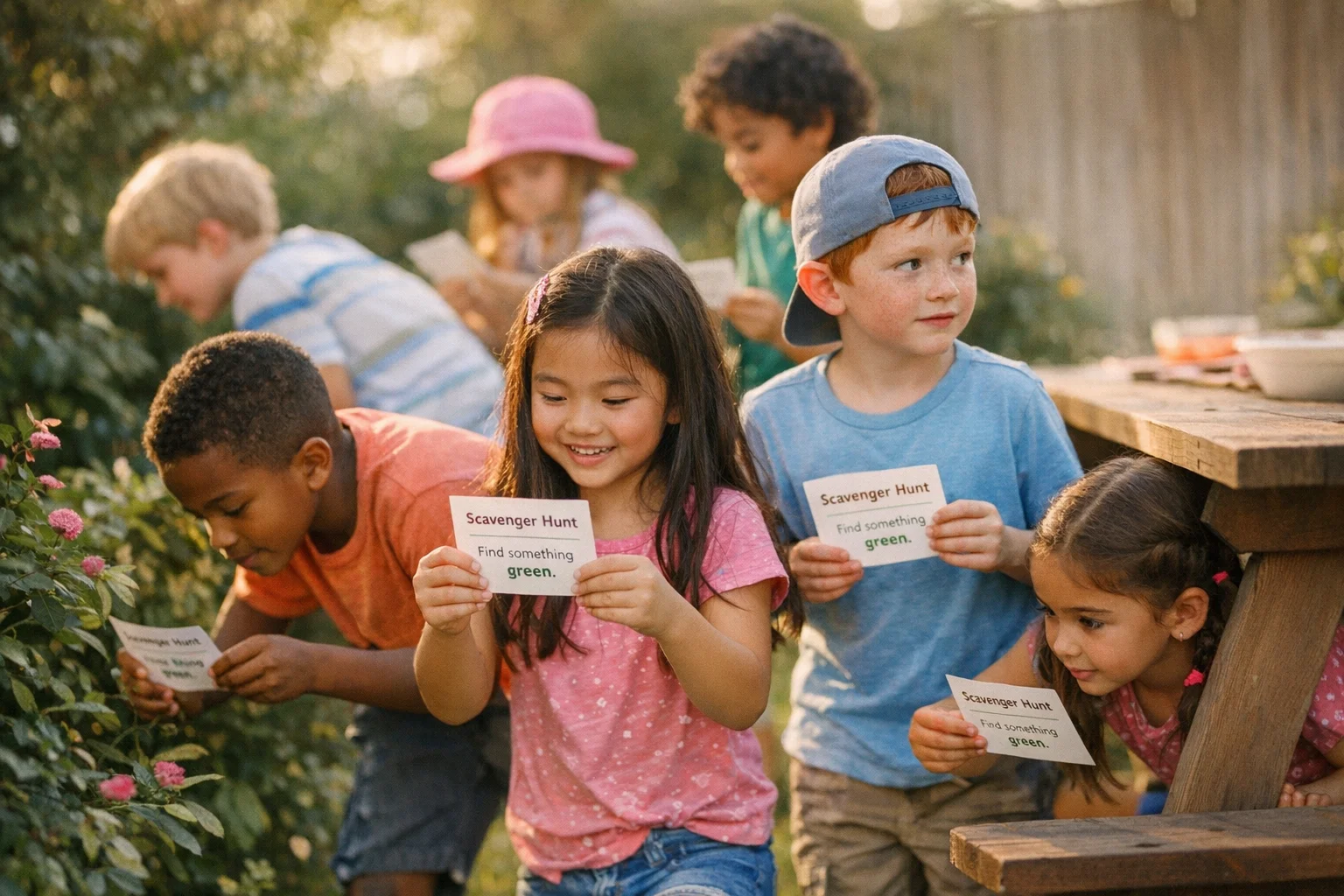
Scavenger hunts turn passive time into active discovery. They’re simple, wildly flexible, and scale from a rainy afternoon to a camp-wide blowout. This guide gives you age-smart ideas, ready-to-run clues, pacing tips, and safety guardrails that keep things fun and inclusive.
At a Glance
- Build around short, movement-friendly challenges tuned to each age band.
- Mix clue styles (photo, Q&A, GPS, riddles) to keep attention high.
- Keep it kind: light scoring, quick wins, and time-boxed rounds.
- Protect kids and nature: consent for photos, basic Leave No Trace, inclusive options.
- Use tools when helpful; pen-and-paper still works great.
Why scavenger hunts work for kids
A good hunt creates just enough structure for curiosity to run. That’s the sweet spot where kids move, notice, and collaborate without realizing they’re practicing real skills.
Playful learning isn’t fluff. Research from the Harvard Graduate School of Education highlights how purposefully playful experiences deepen engagement and transfer to learning back in the classroom. Their Project Zero team has documented practical ways to make learning playful without losing rigor. See the perspective in this Harvard overview of playful learning.
Movement matters, too. For children 6–17, the CDC recommends about 60 minutes of moderate-to-vigorous activity daily. Short, active hunts help chip away at that total in a way that feels like a game, not a mandate. The guideline is summarized in the CDC’s children’s physical activity basics.
How to use this guide
- Pick an age band. Start where the kids are today, not where the adults hope they’ll be.
- Choose a setting. Indoors, backyard, park, classroom, party, or on the go.
- Set a simple frame. 20–30 minutes, 6–12 quick challenges, teams of 2–5.
- Mix challenge types. Photos, Q&A, GPS check-ins, QR scans, and creative tasks.
- Close strong. Celebrate finds, share top photos, and invite one “what we noticed” takeaway.
Ages 3–5: Toddlers & Pre‑K
Attention spans are short. Wins should be quick, visual, and safe to do with a nearby adult. Keep the map tiny. Think room corners, backyard zones, or one section of a park.
- Good goals: Colors, shapes, textures, big vs small, sounds, simple counting.
- Time: 15–20 minutes works. Reset while spirits are high.
- Tip: Pre-place obvious targets. Let kids “discover” without dead ends.
Sample challenges
- [Photo | 10 pts]: Snap something red that’s not a toy.
- [Q&A | 10 pts]: Count three circles. Where did you find them?
- [Audio | 15 pts]: Record a soft sound and a loud sound.
- [Photo | 15 pts]: Find something rough and something smooth together.
- [QR Code | 20 pts]: Scan the smiley face to see your next color.
Ages 6–8: Early Elementary
Kids here love to move and solve small mysteries. Rhyme, rhyme, rhyme. Add light collaboration and choice so everyone contributes.
- Good goals: Rhyming clue trails, simple patterns, basic map skills, teamwork.
- Time: 20–30 minutes with a mid-hunt “bonus” reveal.
- Tip: Offer two options at each stop so shy kids can pick their moment.
Sample challenges
- [Q&A | 20 pts]: Which object is heavier: book or feather? Prove it.
- [Photo | 20 pts]: Recreate a statue pose with your team.
- [Video | 25 pts]: Teach a 5-second hand-wash song at a sink.
- [GPS Check‑in | 30 pts]: Tag the big tree on the south path.
- [Multiple Choice | 20 pts]: Which trash goes where: bottle, peel, wrapper?
Ages 9–11: Upper Elementary
You can turn up the problem-solving. Add light riddles, short sprints, and roles inside teams. Let them self-organize.
- Good goals: Riddles, short codes, observation detail, quick research, leadership turns.
- Time: 30–40 minutes with 8–12 challenges.
- Tip: Rotate roles every two tasks: reader, navigator, recorder, photographer.
Sample challenges
- [Q&A | 25 pts]: Spot a pattern of three. Where does it repeat elsewhere?
- [Photo | 30 pts]: Symmetry hunt: capture a perfectly mirrored scene.
- [Video | 35 pts]: Explain the fastest route between two landmarks.
- [QR Code | 25 pts]: Scan to unlock a riddle. Solve for the next spot.
- [GPS Check‑in | 40 pts]: Log coordinates within 10 meters of the marker.
Ages 10–12: Tweens
They enjoy autonomy and a challenge. Give them choices and time caps. Add creative prompts and light social puzzle design.
- Good goals: Multi-step puzzles, responsible independence, creative evidence, peer teaching.
- Time: 35–45 minutes with optional “boss level” tasks.
- Tip: Post a live leaderboard but keep scores tight to avoid runaway wins.
Sample challenges
- [Photo | 30 pts]: Macro zoom: textures that look alien up close.
- [Q&A | 35 pts]: Decode a simple cipher to reveal a location name.
- [Video | 40 pts]: One-minute mini‑tour of a place most people ignore.
- [Multiple Choice | 30 pts]: Pick the correct map scale for a 500‑meter walk.
- [GPS Check‑in | 50 pts]: Hit three points forming a triangle on the map.
Settings that always work
- Indoors, rainy day. Hide QR codes behind picture frames, under chairs, on book spines. Use photos and Q&A over GPS.
- Backyard or neighborhood. Mark safe boundaries. Plant visible targets. Use “eyes-only” finds rather than collecting natural items. Keep to the spirit of Leave No Trace’s 7 Principles: observe, don’t disturb.
- Parks and trails. Define a short loop. Add sound hunts, texture hunts, or sky clues. A quick LNT briefing turns the hunt into stewardship, not scavenging.
- Classrooms. Turn review content into a walking quiz. Playful approaches improve attention and recall when they’re purposeful, as the Harvard piece on playful learning argues. Keep cues posted at kid height.
- Birthday parties. Short rounds, frequent wins, and collaborative “boss level” finales. Nobody wants a meltdown over a clue.
- Road trips. Window bingo, rest‑stop mini hunts, or “micro‑missions” every 30 minutes.
Ready‑to‑use clue styles kids understand
- Photo evidence. Clear, visual proof anyone can produce.
- Video demos. Great for how‑to tasks and mini‑explanations.
- GPS check‑ins. Perfect outdoors with older kids in a bounded area.
- QR reveals. Hide rhymes, images, or riddles behind quick scans.
- Q&A and Multiple Choice. Low lift, high control for educators.
- Creative artifacts. Sketches, rubbings, leaf silhouettes (without picking), tiny maps.
Formatting tip: Write mini‑mysteries, not directives. “Find the campus landmark older than every student here” lands better than “Take a photo of the oldest building.”
Run time, teams, and scoring that keep it friendly
- Time-box rounds. 20–30 minutes beats an hour-long grind.
- Small teams. Pairs or trios ensure everyone participates.
- Tight scoring bands. Keep point spreads small so late teams still care.
- Visible progress. A whiteboard tally or app leaderboard raises energy.
- Predictable cadence. Brief, hunt, debrief. Kids learn the rhythm and relax into it.
Safety, inclusion, and consent essentials
- Boundaries first. Mark visible lines. Name off‑limits zones out loud. Repeat.
- Right difficulty. If kids stall for more than two minutes, you’ve set it too hard.
- Nature respect. No picking, digging, or moving wildlife. Share a 60‑second briefing using Leave No Trace’s 7 Principles: look, listen, leave what you find.
- Movement with sense. Quick hunts contribute to the CDC’s daily movement recommendation for kids, summarized here: CDC activity basics for children. Keep distances short and surfaces stable.
- Photo and data permission. If you’ll capture or store photos of kids, follow your school/organization policy and laws. In the U.S., COPPA requires parental consent for collecting personal information from children under 13 in online services. The FTC’s plain‑language COPPA FAQ is a useful read.
- Inclusive options. Offer seated alternatives, low‑sensory choices, and a “quiet role” on each team. Success should be available without running, shouting, or bright light.
Quick‑start: 30‑minute setup blueprint
- Minute 0–5: Define the loop. Pick a safe area you can see or patrol quickly. Name 8–10 stops.
- Minute 6–10: Draft clues. Alternate types: photo, Q&A, QR, creative. Keep text short.
- Minute 11–15: Place markers. Tape QR codes, stash laminated rhymes, drop a chalk arrow.
- Minute 16–20: Build a tally. Print a one‑page score sheet or open an app leaderboard.
- Minute 21–25: Pre‑brief. Show boundaries, model one complete clue, assign roles.
- Minute 26–30: Launch. Stagger starts by 20 seconds. Observe, nudge, and capture highlights.
Digital or app‑based? When software helps
Paper works. That said, software saves time when you want automation, easy media capture, or you’re managing lots of kids.
- Challenge variety. Apps support mixed media, GPS, QR, timed unlocks, and instant hints.
- Automation. Auto‑scoring, live leaderboards, and photo/video galleries reduce the admin load.
- Flexible access. Browser or mobile app options help when not every kid has a phone.
- Scale. Useful for school‑wide days, libraries, camps, museums, and city activations.
Scavify was built for exactly this kind of interactive engagement. If you’re running a classroom review, a family field day, or a park program, the browser‑plus‑app setup and challenge variety make it simple to launch in minutes without turning playtime into paperwork.
Classroom tie‑ins that actually stick
- Literacy. Vocabulary hunts with photo examples, synonyms hidden behind QR codes, or “find the metaphor in the room.”
- Math. Angle hunts with protractors, perimeter races around safe areas, or scale readings.
- Science. Texture transects, micro‑observations, and quick claim‑evidence‑reasoning videos.
- Social studies. Landmark storytelling, artifact comparisons, and primary‑source mini quests.
A pattern we keep seeing: small, movement‑rich hunts land better than epic ones. Keep it short, then run a second round with slightly higher difficulty. That rhythm builds confidence and reduces behavior issues.
Printable‑style checklists you can copy
- Starter set (any age): 2 photos, 2 Q&A, 1 QR, 1 creative, 1 team selfie, 1 “teach us something” video.
- Nature light: 3 observation photos, 1 sound clip, 1 sky description, 1 “leave what you find” sketch, 1 LNT pledge.
- Classroom review: 4 Q&A tied to this week’s content, 2 multiple choice, 1 peer‑explain video, 1 “example in the real world” photo.
Debrief that kids remember
- Gallery walk. Show two standout photos from every team.
- Micro‑reflections. One thing we noticed, one thing we’d change next time.
- One last laugh. A blooper reel or a goofy team pose resets the room’s mood.
FAQs
What’s the ideal length for a kids’ scavenger hunt?
20–30 minutes is the sweet spot for most groups. Short rounds keep energy high and leave room for a second quick game if kids want more.
How many clues should I include?
Aim for 8–12 short tasks. Mix formats so different kids get different ways to shine.
How do I handle mixed ages?
Pair older kids as navigators or readers with younger kids as spotters or photographers. Use two difficulty tracks feeding the same finish.
Is it OK to do scavenger hunts in parks or on trails?
Yes, with respect. Build observation‑based tasks and remind kids to follow Leave No Trace’s 7 Principles. Avoid collecting natural items and keep everyone on durable surfaces.
What about safety and photos?
Set clear boundaries, avoid roads and water, and require buddy systems. If photos or names will be stored or shared online, follow your organization’s policy and consult the FTC’s COPPA FAQ for kids under 13.
How competitive should it be?
Lightly. Tight scoring bands and bonus points for teamwork or creativity keep it friendly. Celebrate multiple “wins,” not just first place.
Can scavenger hunts support learning objectives?
Absolutely. Purposeful play supports engagement and retention. The Harvard Graduate School of Education outlines how to make learning playful without losing rigor in this overview of playful learning.
Do hunts count as physical activity time?
They can contribute. For 6–17 year olds, the CDC recommends around 60 minutes of moderate-to-vigorous activity daily. Short, movement‑rich hunts help. See the CDC’s children’s activity basics.
Design the environment, not the excitement. Scavenger hunts give kids just enough structure to discover what was there all along.