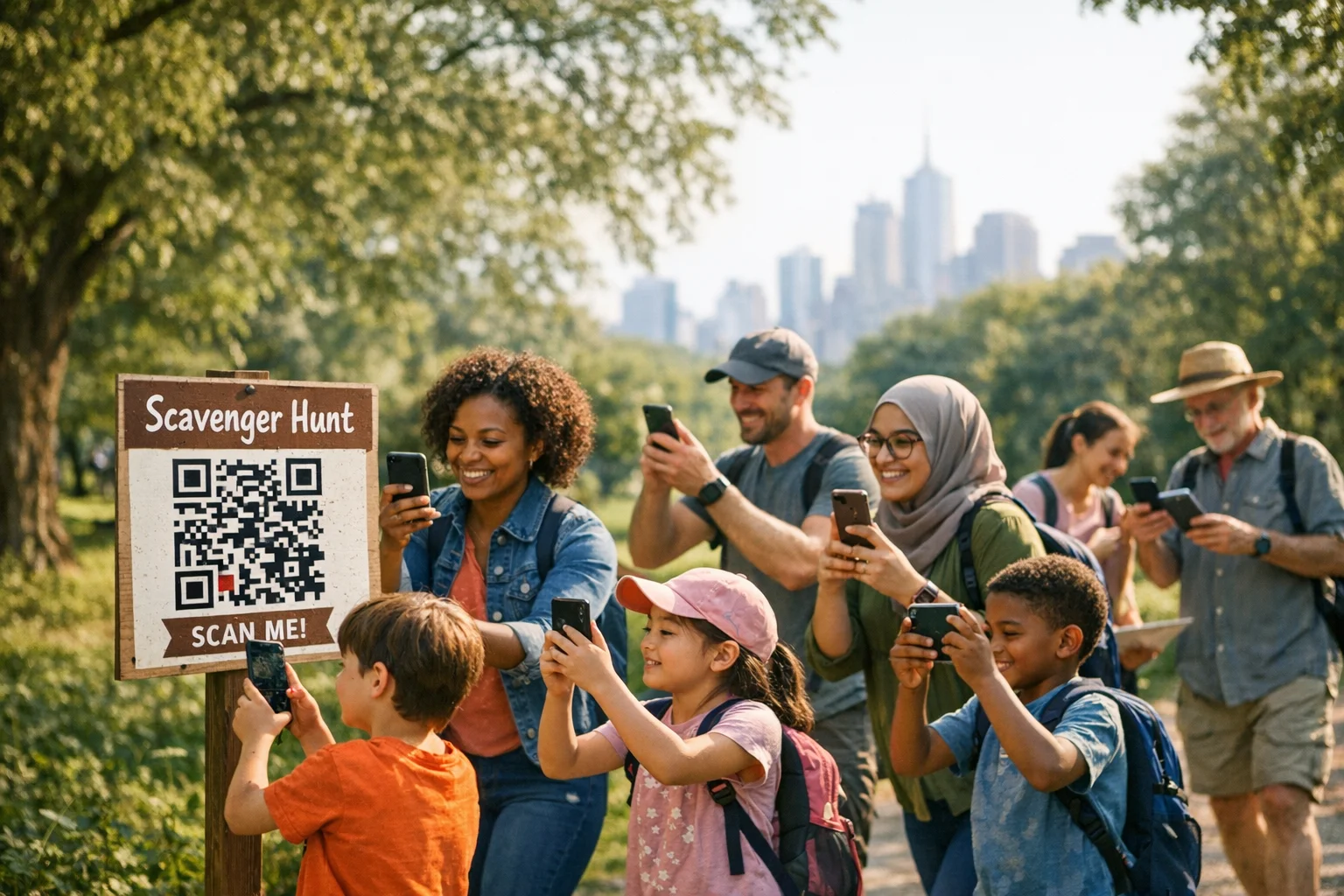
Outdoor scavenger hunts are a simple way to turn any park, campus, or neighborhood into a live, moving game. Done well, they create real interaction, not forced participation. The right mix of clue design, pacing, and simple logistics is what separates “that was cute” from “that was the best part of the day.”
At a Glance
- Design formats that fit the space. Photo, GPS check‑ins, riddles, and QR hunts each create different behaviors.
- Make safety and stewardship non-negotiable. Plan for heat, ticks, and terrain. Follow Leave No Trace.
- Keep scoring simple and visible. Momentum builds when teams see progress in real time.
- Use tech where it reduces work. Automation beats clipboards when you scale to bigger groups.
What counts as an outdoor scavenger hunt today
An outdoor scavenger hunt is any structured set of challenges that moves people through a physical space to find, capture, or solve things. The format can be classic lists, media-based prompts, GPS check‑ins, QR codes, or puzzle trails.
A useful mental model: the space is your board, people are your pieces, and challenges are your mechanics. Change the mechanics and the whole experience shifts.
Choose the right format
Picking a format is less about novelty and more about matching the energy and terrain.
Classic list hunts
Simple prompts to find or observe items. Fast to launch. Good for mixed ages and open areas. Avoid long lists. Momentum fades after item 12.
Photo and video hunts
Teams capture proof on their phones. This encourages creativity and social proof. Works beautifully in parks, downtowns, and campuses.
GPS check‑in hunts
Participants check in at map points to unlock tasks. Great for trails, gardens, and campuses where movement is the point.
QR code and hidden marker hunts
Place codes on signs, cones, or temporary stakes. Use sparingly in public spaces. Always get permission and remove everything you place.
Progressive and puzzle trails
Clues chain together. Each solution reveals the next location. Best when you can control the route and timing.
Nature and stewardship hunts
Prompts center on observation, ecology, or micro-actions like trash pickup photos. Very effective for schools, camps, and community days.
Plan with this practical framework
Strong hunts usually come from clear choices up front.
- Objectives: Connection, orientation, content capture, or pure play. Pick one primary objective and write it at the top of your plan.
- Audience: Age range, mobility, group size, comfort with phones. Design for the least experienced participant, not the most eager one.
- Space & route: Map natural loops and safe crossings. Avoid dead-ends unless they are final reveals.
- Time window: Most groups stay engaged for 45–90 minutes. Longer runs need pacing breaks and visible progress.
- Weather & season: Build a shade plan and a rain plan. Default to morning or late afternoon in hot climates.
- Permissions & neighbors: Confirm what you can place, where teams can go, and any photo restrictions. Keep nearby residents and staff on side with a quick heads-up.
- Safety & accessibility: Sun, heat, ticks, footing, and accessible routes. Put these into the route, not just the waiver.
- Teaming & scoring: Teams of 3–6 keep everyone involved. Use points that reflect effort, not just quantity. Add one or two high-value challenges to create drama.
- Toolkit & roles: One owner, one comms lead, one scorer. If tech handles scoring, reassign the scorer to on-course support.
- Content plan: If you want photos you can use later, say so up front and give examples that produce the shots you need.
Outdoor scavenger hunt ideas for kids
Formats and prompts shift by age. Keep movement short and rewards fast.
Ages 4–7: playful discovery with caregivers
Keep routes tight with visible landmarks. Use photos and simple check‑ins.
- [Photo | 20 pts]: Make a leaf “smile” on a bench seat.
- [GPS Check‑in | 30 pts]: Tag the shady tree with the biggest trunk.
- [Q&A | 20 pts]: How many steps lead to the slide?
- [Photo | 30 pts]: Balance a pinecone on your head for three seconds.
- [QR Code | 40 pts]: Scan the ladybug sign near the garden gate.
Ages 8–12: adventure plus light puzzles
Add gentle riddles, short sprints, and team choices.
- [Q&A | 30 pts]: Statue’s friend points which direction?
- [Photo | 40 pts]: Recreate an animal pose using the whole team.
- [GPS Check‑in | 40 pts]: Reach the bridge where water sounds loudest.
- [QR Code | 50 pts]: Decode the word hidden by the playground map.
- [Video | 60 pts]: Teach a 10‑second park safety rhyme.
Teens: challenges with ownership and style
Let them show skill. Set clear boundaries, then let creativity breathe.
- [Video | 70 pts]: One-take lip sync at a public art piece.
- [Photo | 60 pts]: Forced perspective of someone holding the gazebo.
- [GPS Check‑in | 50 pts]: Highest legal viewpoint in the park.
- [Q&A | 50 pts]: Find a sign that changes your route choice. Why?
- [Photo | 80 pts]: Team shape that spells the town’s initials.
Ideas for groups, teams, and events
These formats scale well for company days, conferences, and public activations.
Corporate team building in a park or downtown
Blend problem solving with moments that invite quick laughter. Keep it moving.
- [Photo | 40 pts]: Recreate your team name with only found objects.
- [GPS Check‑in | 60 pts]: The spot locals choose for a lunch break.
- [Q&A | 50 pts]: Oldest year you can find on a building marker.
- [Video | 70 pts]: Two-person trust walk guiding around a safe obstacle.
- [QR Code | 80 pts]: Hidden message at a permitted placement point.
Conferences and campuses
Make it an orientation with purpose. Help people find what matters, fast.
- [GPS Check‑in | 40 pts]: Closest quiet nook to recharge or focus.
- [Photo | 40 pts]: Team selfie with a campus tradition symbol.
- [Q&A | 50 pts]: Which building offers free water refill stations?
- [Video | 60 pts]: 15‑second “how to” for navigating the venue.
- [QR Code | 70 pts]: Scan at the help desk to unlock a time‑bonus clue.
Tourism and public activations
Design for drop‑in players and families. Offer short wins and a finale moment.
- [Photo | 30 pts]: Something that smells like this town.
- [GPS Check‑in | 40 pts]: The most-photographed corner downtown.
- [Q&A | 50 pts]: Local food mentioned on a mural or sign.
- [Video | 60 pts]: Teach a 5‑second local phrase to the camera.
- [QR Code | 80 pts]: Final code at the visitor center prize table.
Writing better outdoor clues
Most hunts fail in the clue writing. Either too obvious or too clever. Aim for “solve in 30–90 seconds” with a small aha.
- Anchor to sensory details. Sound of water, smell of herbs, rough stone.
- Point without naming. “Find the bench older than your phone,” not “Find the wooden bench.”
- Use triangle hints. Each clue should have three light hints, not one blunt one.
- Vary the solve. Mix riddle, observation, simple cipher, and direction.
Quick examples you can steal:
- Riddle: “I count steps but never walk. Find me near the school’s heart.”
- Observation: “Which tree wears a silver tag ending in 7?”
- Direction: “From the sundial, take fifty quiet paces to the lion.”
- Cipher: “Shift each letter forward one to reveal the cafe name.”
Safety, stewardship, and accessibility that actually work
Make these choices before anything else. They protect your people and the space.
- Heat and sun: Choose cooler start times, give shade breaks, and set hydration prompts in the challenge list. Build decisions around official guidance like the NWS heat safety guidance. (weather.gov)
- Ticks and insects: In grassy or wooded areas, recommend long socks, repellent, and end‑of‑event tick checks in your briefing. The CDC tick prevention guidance is the baseline to share in pre‑event emails. (cdc.gov)
- Leave No Trace: Avoid off‑trail shortcuts, do not bury or leave props, and keep noise respectful. Share a one‑liner and link to the 7 Leave No Trace principles in your welcome message. (lnt.org)
- Accessibility: Choose routes with firm, stable surfaces and clear sightlines. Offer alternatives when terrain narrows. A practical public‑sector checklist like NYC’s Planning an Accessible Event guide helps convert good intentions into real accommodations. (nyc.gov)
Run-day operations that keep energy high
Small operational choices make big differences in how the day feels.
- Arrival: Greet with a simple briefing board. Post the time window, boundaries, and a three‑rule code of conduct.
- Launch: Stagger starts by 2–3 minutes to reduce crowding at clue one. Give a sample solved clue so nobody gets stuck early.
- During play: Broadcast light nudges at the 20, 40, and 60‑minute marks. Share a top‑three leaderboard to spark a final push.
- Field support: One roving host keeps an eye on hotspots and helps teams that stall. It is usually the most valuable staffer on course.
- Finish: Close with a visible clock, quick debrief question, and two photo prompts that bring teams together for a last laugh.
Should you use an app or go analog?
Paper works for very small groups in contained spaces. The moment you care about photos, real‑time scoring, or route flexibility, tech reduces friction. In our experience, the right tool clears three hurdles: setup time, day‑of logistics, and proof of participation.
Scavify fits when you want challenge variety, automation, and easy launch without duct‑taping multiple tools. You can run in the mobile app or a browser, mix Photo, Video, GPS Check‑in, QR Code, Multiple Choice, and Q&A challenges, and scale from a single field trip to a multi‑city corporate activation. Use it to handle prompts, submissions, scoring, and leaderboards while you focus on safety and storytelling.
If you stay analog, simplify. Fewer clues, bigger point gaps, one trusted scorer, and a clear finish line.
Measuring success
Measurement is how outdoor play becomes a repeatable program.
- Participation rate: Registered vs. active teams. Aim for visible wins in the first five minutes.
- Challenge completion mix: Which mechanics hit. If photos dominate, add a couple of location check‑ins next time.
- Dwell time by zone: Where people lingered. Good for sponsors and operations.
- Quality of submissions: Do your prompts generate shareable moments you can actually use?
- Feedback signals: One fast pulse question at the finish. You learn more from five words than a 20‑question survey everyone skips.
FAQs
How long should an outdoor scavenger hunt last?
Most outdoor hunts land well between 45 and 90 minutes. Shorter than 30 minutes feels rushed. Longer than two hours needs breaks, shade, and visible progress or you will lose energy.
What group size works best?
Teams of 3–6 usually keep everyone engaged without one person carrying the group. For big events, run many small teams rather than a few large ones.
Do I need permission to place clues or QR codes in a park?
Yes, if you are attaching anything to public property or placing items beyond a short event window. Contact the land manager or parks office. If you cannot place items, use GPS check‑ins, observation clues, or staff‑held signs.
How do I plan for heat and sun?
Schedule cooler hours, set waypoints with shade, and include hydration prompts in the challenge list. Share a link to official heat safety resources in your pre‑event email and have a simple “stop if you feel off” rule at the briefing.
What is a good prize structure?
Use recognition plus one or two small prizes. Think top team, best photo, and most creative solve. Keep the awards tight so you can wrap within ten minutes.
How do I prevent cheating without killing the fun?
Clarity and visibility. Use photo or video proof, GPS radius checks where possible, and a couple of high‑value challenges that require presence. Publish boundaries and consequences once. Then focus on celebrating the honest wins.
How do I make it accessible for different mobility levels?
Pick stable surfaces, avoid steep grades, and offer alternative versions of any terrain‑dependent clue. If a path narrows, provide a parallel prompt at a nearby accessible location and count it the same.
What if the weather turns?
Have a go/no‑go decision time on the calendar and a short indoor fallback with photo and riddle prompts. Tell everyone the plan before event day so a switch feels smooth, not chaotic.
A well‑designed outdoor scavenger hunt turns a space into a story people finish together. If you want to scale without extra staff, Scavify’s app and browser options make setup and scoring simple while keeping the creative parts in your hands.