Solutions
Your first hunt, live this afternoon.
Free to start · No download for participants
Explore standout local team building ideas with indoor, outdoor, and low-lift options for company events and offsites.
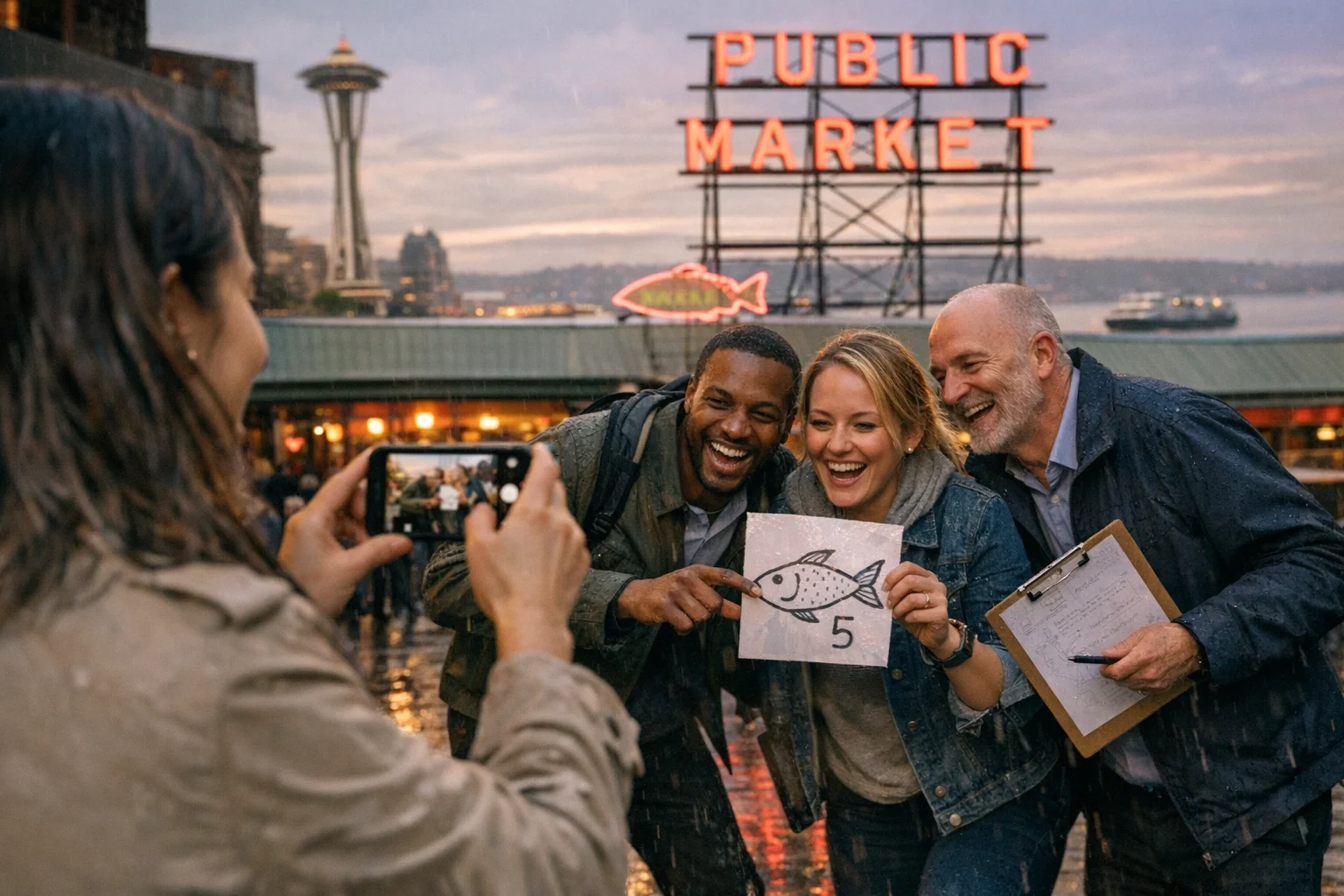
Seattle rewards teams that actually get out into the city. Water, hills, tight neighborhoods, and big public spaces give you more options than the standard bowling-and-pizza routine. The trick is matching your group’s energy to the right corner of the city and building in just enough structure to keep things moving.
This guide is built from patterns we keep seeing across company offsites and team days in Seattle. It’s practical, rain-ready, and designed to make participation feel natural instead of forced.
Travel time reality. Cross-town moves add friction. Plan around one neighborhood and let the activity change, not the venue.
Rain is a feature, not a bug. Pick formats that tolerate drizzle or have an indoor pivot within 5 minutes’ walk.
Low-lift beats high-production. The best days are structured but not overproduced. Think clear prompts, quick wins, and visible progress.
Permits and parks. If you’re using a public park for organized games or large gatherings, review the city’s rules and apply for the right permissions via the Park Use Permit process. The details are straightforward and save headaches on the day. See the city’s Park Use Permits page.
1) App-powered Pike Place + Waterfront scavenger hunt (Downtown). Fast-moving, photo-first challenges through the Market, Post Alley, and the waterfront boardwalk keep even big groups engaged. Keep mobility needs in mind during peak crowds, and set a tight route so teams don’t scatter. Pair with a short awards huddle in Victor Steinbrueck Park. For Market context and hours, scan the official Pike Place Market site.
2) Discovery Park micro-adventure with trail prompts (Magnolia). A 2.8‑mile loop, wide paths, and big views make this perfect for small-group exploration plus lightweight tasks. Use clear rendezvous points like the Environmental Learning Center. Route and conditions are well covered by the Washington Trails Association page for the Discovery Park Loop.
3) Lake Union kayak flotilla + floating trivia (South Lake Union/Westlake). Rent singles/doubles and run a waypoint circuit near MOHAI and houseboats. Keep radios or a shared chat channel for simple trivia prompts at each buoy or dock. Wind picks up in the afternoon; morning slots paddle easier.
4) Seattle Center campus challenge (Lower Queen Anne). Space Needle plaza, International Fountain timing, and Armory nooks give you a compact, crowd-friendly canvas. Great for mixed fitness levels with plenty of seating, cover, and restrooms close by.
5) Ballard Locks observation game (Ballard). Teams predict vessel counts, spot salmon at the fish ladder, and capture oddities in the gardens. It’s half science, half people-watching, and it always gets surprisingly competitive.
6) Glassblowing mini-workshop (Belltown). Guided glass experiences flip the usual “spectator” dynamic. People leave with something they made, not something they watched. Small-group rotations keep energy high while others cheer and film.
7) Hands-on cooking class sprint (Downtown/Belltown). Two-hour formats at places like Hot Stove Society or The Pantry turn into instant collaboration labs. Pick menus that divide naturally into stations so everyone contributes. Quick tasting at the end, short toast, you’re done.
8) Escape room face-off (Belltown/Downtown). Good rooms turn quiet teammates into puzzle MVPs. Head-to-head runs with a shared debrief create natural storytelling for the rest of the day. Keep slots staggered and start the debrief with “What actually cracked it?”
9) Pinball museum playoffs (International District). Fixed-time high-score ladders beat endless free play. Rotate teams through eras or categories to balance skill. It’s tactile, noisy, and judgment-free in the best way.
10) Neighborhood coffee cupping challenge (Capitol Hill or Ballard). Local roasters teach a simple tasting format. Teams map flavor notes, pick a house blend, and design a one-page brand story. It’s quick, sensory, and indoor-weatherproof.
11) Urban photo safari with constraint cards (Pioneer Square). Give teams 6 creative constraints and a 45‑minute clock. Land on alleys, totems, ironwork, and light wells. The mini gallery share after is where the bonding actually happens.
12) Museum remix hour (U District or Seattle Center). Choose one tight wing at a museum and send teams to find “the most compelling object” under different criteria: craft, surprise, story, risk. Three-minute lightning talks keep it snappy.
13) Waterfront “five senses” walk (Downtown). Teams catalog sights, sounds, textures, and small details along the piers. The constraint of noticing, then naming, focuses even the most distracted group.
14) Parks picnic plus lawn game circuit (Gas Works, Golden Gardens, Jefferson Park). Keep four games on a loop and rotate teams every 10 minutes. Clear scoreboard, one roaming referee. If you’re reserving shelters or bringing vendors, double-check Park Use Permits and picnic reservations.
15) Capitol Hill mural bingo. Create a mural-and-street-art grid and send trios to fill lines with clever photos. Add a “talk to a local shopkeeper about the piece” wildcard to nudge real interaction.
16) Ferry brainstorm sprint (Seattle–Bainbridge). Out-and-back on the boat equals a perfect 90–120 minutes for a sharp problem-framing session. Use table tents for small groups, then one share-out before docking.
17) CWB sailing sampler (South Lake Union). Short, coached sails flip roles rapidly: helm, lines, lookout. The rhythm builds trust without forcing it. It’s hard to clutch a phone while trimming a jib, which is exactly the point.
18) Indoor bouldering showdown (Georgetown or Fremont). Set easy-to-moderate problems only, and score on attempts rather than sends to keep it inclusive. Rotations every 12 minutes prevent bottlenecks.
19) Capitol Hill food-crawl “tiny bites” draft. Give teams a small budget and a map of 6 blocks. The goal is a progressive menu with story and sequence. They present their route and why it works. The tasting bites become evidence.
20) Volunteer repack or cleanup with a visible finish line. Food sort, shoreline cleanup, or kit-building that can be completed in under two hours. The key is a defined goal posted where people can see the stack grow.
21) Bean‑to‑bar chocolate factory tour and tasting (Wallingford/Stone Way). A short tour followed by guided tasting is a reliable crowd-pleaser. It’s collaborative without being loud, and it works for mixed groups. Check Spinnaker Chocolate’s visit page for current tour and class options.
Match energy to environment. If your team is coming off a heavy strategy morning, choose something kinetic and simple. After a travel day, go lighter, closer, and seated.
Think in 90-minute blocks. Seattle activities run best in crisp windows. Enough time to immerse, not enough to drift.
Design for the 20 percent. Someone will be on a deadline, nursing an injury, or introverted. Build formats that let them contribute without spotlight pressure.
Rain pivots ready to go. For every outdoor choice, have an indoor alternative within the same neighborhood. “If it drizzles, we still go. If it pours, we switch to X.”
Plan public-space etiquette. The Market, waterfront, and parks are shared spaces. Keep group sizes split into pods, skip amplified sound, and set a simple code of conduct.
When an app-based hunt fits, we usually combine one tight neighborhood, progressive prompts, and live scoring. It keeps groups moving and gives introverts room to contribute via puzzles, not just volume.
Here’s a Seattle set that works across Pike Place, the waterfront, and Seattle Center:
Scavify helps here with challenge variety, automated scoring, and easy launch for hybrid or in-person teams. It’s built for quick setup and real-time momentum, not hours of pre-work.
Stick to indoor standbys near transit: cooking classes, glassblowing mini-workshops, escape rooms, museum remix hours, or a compact scavenger hunt at Seattle Center with covered waypoints. Always keep a 90-minute backup option in the same neighborhood.
If you’re organizing structured activities, bringing vendors, or reserving shelters, review the city’s rules and apply if needed. The process and contacts are outlined on the Park Use Permits page.
Seattle Center, Pike Place/Waterfront, and South Lake Union are compact and flat by Seattle standards. Each has indoor cover, restrooms, and food within minutes.
Discovery Park’s loop is the classic: wide paths, variable scenery, and easy wayfinding. The WTA overview of the loop gives simple route guidance and seasonal notes.
Trios and quartets are the sweet spot. Big enough for varied skills, small enough to move through crowds without bunching.
Neighborhood photo safaris with constraint cards, mural bingo, ferry brainstorms, or a parks picnic circuit are all high on engagement and low on spend. Structure beats spectacle.
Yes. Combine a Pike Place scavenger set with a short tasting gauntlet and a quick awards huddle on the waterfront. Check official hours on Pike Place Market’s site to time around crowds and closures.
A guided chocolate tasting hits the right note: short, sensory, and celebratory. Spinnaker Chocolate’s visit page lists tours and classes near Stone Way for an easy finale.
Seattle rewards teams that choose momentum over production. Pick a neighborhood, set clear prompts, and give people something real to discover. If you want an easy, high-energy format to tie it together, Scavify is built to make the city itself the activity.