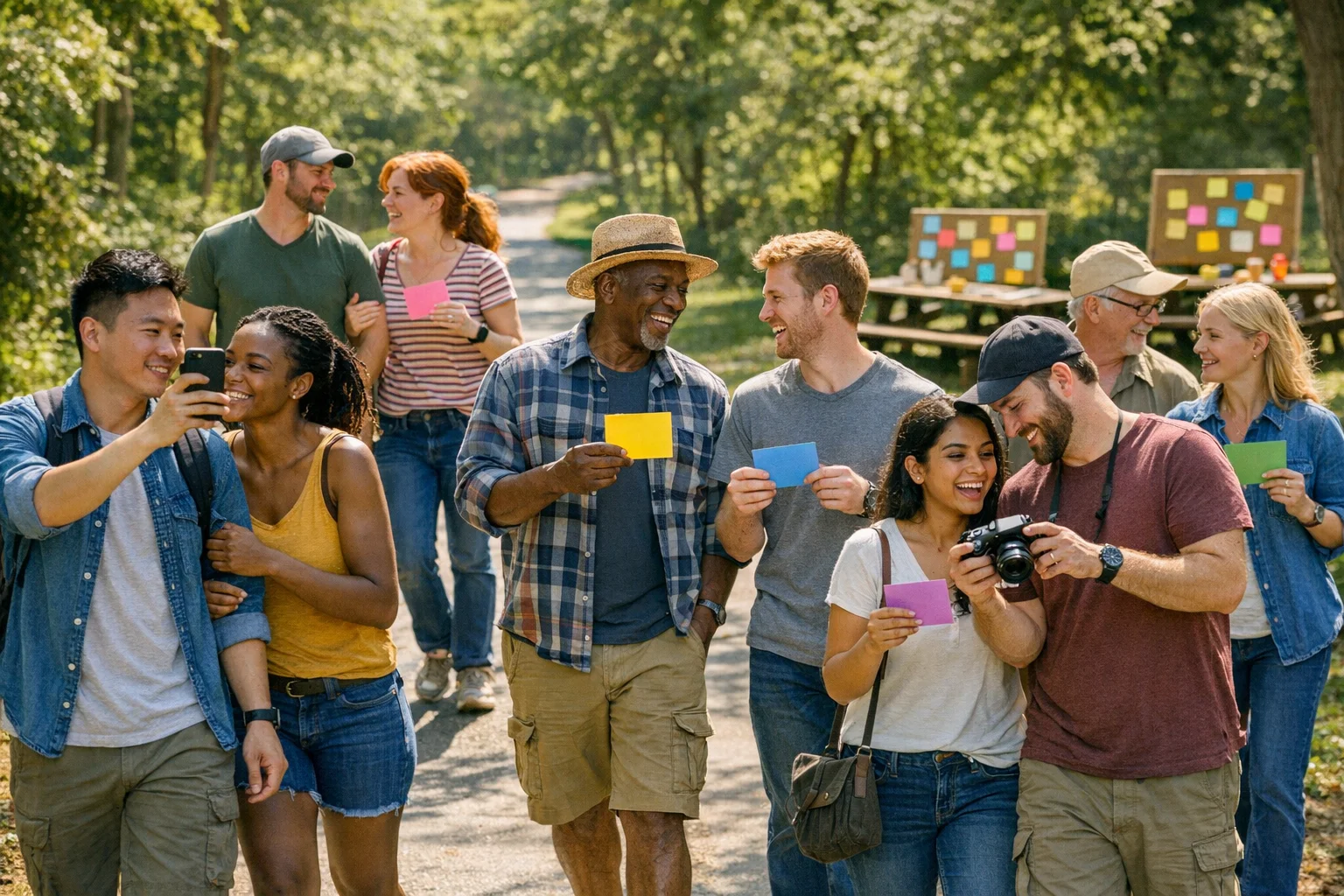
Why these team offsite ideas work
Most offsites fall flat for the same reasons meetings do: vague purpose, passive formats, and too much talking from the same three voices. What changes the outcome is structure that creates movement, novelty, short feedback loops, and psychological safety so people will actually participate.
If you remember nothing else, remember this: pick a clear outcome, then run activities that make people interact in small groups, move their bodies, and make decisions quickly. The rest is production value.
At a Glance
- Design principle: Blend movement, small-group rotation, and quick decisions to keep energy up.
- Anchor your purpose: Name 1 to 2 outcomes up front and tie every block to them.
- Make it safe to contribute: Psychological safety unlocks ideas and buy-in.
- Prefer outdoors or walking blocks: Walking reliably boosts idea generation.
- Measure lightly: Track interactions, artifacts created, and next steps, not just smiles.
How to choose and shape the right offsite
Use these filters before you lock anything in:
- Outcome clarity: Pick the single most important outcome, like align on 3 priorities, strengthen cross-team trust, or generate 20 testable ideas. A focused purpose dramatically improves design decisions, a pattern echoed in Harvard Business Review’s guidance on effective offsites. (hbr.org)
- Psychological safety: If you need honest debate or fresh ideas, bake in rituals that normalize risk-taking. Google’s Project Aristotle points to psychological safety as a core ingredient of effective teams, summarized in the re:Work guide on team effectiveness. (rework.withgoogle.com)
- Movement and environment: When you want idea generation, add walking blocks. Stanford research found walking increases creative output compared to sitting, even on a treadmill indoors, as reported in the Stanford Report on walking and creativity. (news.stanford.edu)
- Format fit: In-person time outperforms screens for raw idea generation, while virtual can be fine for selecting among options. That tradeoff shows up in Stanford GSB’s review of virtual vs in-person ideation. (gsb.stanford.edu)
17 team offsite ideas that actually land
These formats are designed to feel like play while producing useful outcomes. Mix and match.
1) City Story Hunt
Turn the neighborhood into your workshop. Small teams collect photos, quick interviews, and micro-observations tied to your theme, then assemble a 5-frame story you can present and reuse.
- Why it works: Movement, novelty, and short deadlines spark participation.
- How to run: Frame a theme, seed a map with 6 to 8 stops, set tight timeboxes, end with rapid-fire showcases.
- Scavify fit: App-based prompts, GPS check-ins, and auto-scoring keep it smooth at any size.
Example challenges to seed your hunt:
- [Photo | 20 pts]: The most surprising team ritual you spot in the wild
- [Video | 40 pts]: A 10-second street pitch for our next idea
- [GPS Check-in | 15 pts]: Where locals actually line up for lunch
- [Q&A | 25 pts]: One thing customers wish existed but doesn’t yet
- [Multiple Choice | 10 pts]: Which landmark was finished last year?
2) Walking Workshop Sprints
Pair people up. Assign each pair a question. Send them on a walking loop and rotate partners twice. Return to capture highlights on paper cards and cluster them for next steps.
- Why it works: The walk changes tempo and boosts idea generation. Stanford’s work found walking sessions produced more novel uses than sitting sessions, even indoors, which is handy if the weather flips. See the Stanford creativity and walking summary. (news.stanford.edu)
- Tip: Keep prompts concrete, not abstract. “Two low-lift ways to reduce customer wait time,” not “innovate on experience.”
3) Service Sprint, Not a Photo Op
Pick a cause that maps to your company’s values. Give teams real tasks with a visible finish line, like restocking a pantry, assembling kits, cleaning trails, or recording how-to videos for a nonprofit.
- Why it works: Shared effort creates trust without forced vulnerability.
- Make it useful: End with a 5-minute debrief on what made coordination smooth or clunky. Capture two process tweaks to bring back to work.
4) Culinary Collaboration Lab
Shared cooking with constraints. Each table gets a base recipe and three curveballs to integrate. Judges score for taste, speed, and teamwork.
- Why it works: Clear roles emerge under time pressure and it is delicious.
- Pro move: Keep dietary needs inclusive by letting teams swap curveballs once.
5) Maker Build: Rube Goldberg Edition
Teams get a bin of odd parts and a simple goal like ringing a bell using at least eight chain reactions.
- Why it works: Playful constraints force creative problem solving.
- Debrief: Ask each team to name one unblocked moment and one jam, then trade fixes.
6) Field Research Safari
Send pairs to observe users or frontline teams. Give them a clear, ethical script and a checklist. Return with photos, quotes, and a top-5 friction list.
- Why it works: Reality beats assumptions. Patterns show up quickly.
- Make it stick: Convert the top frictions into owner-backed experiments.
7) Mentor Roulette
Set up short, high-rotation conversations across levels and functions. Use prompt cards so nobody wastes the first minute finding a question.
- Why it works: Reduces status barriers and spreads tacit knowledge.
- Safety cue: Start with low-stakes prompts, build to spicier ones later.
8) Park Pitch Picnic
Gather in a green space. Teams craft 2-minute pitches solving a real issue. Everyone gets fake budget to “fund” pitches they believe in. Top ideas get a fast path to pilot.
- Why it works: Outdoors lowers formality and invites bolder thinking. Nature time has documented attention benefits that help people refocus between blocks. Use it, then capture decisions. (hbr.org)
- Logistics: Shade, seating, and sound matter more than snacks.
9) Choose-Your-Own Learning Tracks
Offer parallel mini-sessions people can opt into. Repeat the best ones later in the day so nobody feels FOMO.
- Why it works: Autonomy increases engagement. People lean in when they chose it.
- Pro tip: Cap sessions short, then reconvene for a cross-pollination share-out.
10) Silent Co-creation, Loud Show-and-Tell
Give teams a clear brief and 45 minutes of quiet build time with craft supplies or whiteboards. No talking until the reveal.
- Why it works: It evens the playing field for introverts and prevents loud-first bias.
- Debrief: Ask what changed once words entered the room.
11) Neighborhood Good Deeds Hunt
Blend a scavenger hunt with micro-acts of service. Capture before-and-after photos, log impact stats, and share quick stories.
- Why it works: Concrete wins plus friendly competition.
- Scavify fit: Automates prompts, proof, and scoring, so you can focus on safety and impact.
12) Analog Afternoon
One block with devices parked. Try sketching, paper prototyping, or map-making.
- Why it works: Getting hands on breaks ruts. People listen better when nothing pings.
- Make it inclusive: Offer tactile aids so non-drawers can still contribute.
13) Constraint Hackathon
Short, scrappy build focused on a single constraint, like “no new budget” or “ship in two weeks.”
- Why it works: Constraints sharpen priorities and force creative tradeoffs.
- Guardrail: Ban gold-plating. Reward the smallest testable thing.
14) Walk-and-Talk One-on-One Circuits
Map a loop with 3 conversation zones. Pair people for 10 minutes per zone, then swap.
- Why it works: Movement plus intimacy opens candid conversation. It also avoids the big-room performative dynamic.
- Hybrid twist: Remote folks take their own walk and join for the capture.
15) Art Crawl Remix
Museum or gallery visits with prompts that link art themes to your work. End with lightning talks where teams connect an exhibit to a customer problem.
- Why it works: New stimuli, shared interpretation, and low-stakes speaking.
- Tip: Give a simple note-capture template so insights return to the office.
16) Micro-adventure With Reflection
Kayaking, bouldering, orienteering, or an easy urban hike with a structured debrief on risk, roles, and signals.
- Why it works: Novel tasks expose team dynamics without forced vulnerability.
- Safety first: Choose inclusive difficulty and let people opt into roles.
17) Campfire Pre-mortem
Circle up, real or metaphorical fire. Ask teams to imagine your biggest initiative failed and map the chain of events that led there. Close by naming the two risks to start reducing Monday.
- Why it works: It is honest, a little mischievous, and highly actionable.
- Facilitation note: Start with anonymous idea seeding to reduce first-speaker bias.
A simple flow that keeps energy high all day
Most teams benefit from a day that alternates between intensity and reset. Here is a simple pattern that travels well:
- Start with purpose and permission: Name the outcome and what participation looks like. Remind people we will rotate, move, and build.
- Small-group block: Choose any idea above. Keep timeboxes tight.
- Walking reset: 15 to 25 minutes of walk-and-talk or solo loop. Creativity tends to pop here, then carries back into the room. The Stanford walking study summary is a handy reference if you need to sell this to skeptics. (news.stanford.edu)
- Make it visible: Convert insights into artifacts. Photos, sticky clusters, one-pagers, or a simple scoreboard in the app.
- Decision block: Fund ideas with fake budgets or dot votes. Capture next steps and owners.
Measuring success without killing the vibe
Light metrics keep you honest without turning your offsite into a dashboard. Track:
- Interaction density: How many unique 1 to 1 or small-group interactions did people have, not just headcount in a room.
- Artifacts created: Storyboards, friction lists, prototypes, decisions documented.
- Momentum signals: Clear owners, near-term experiments, follow-up dates.
- Safety signals: Did everyone contribute at least once in each block, and did norms make it easier to speak up. Google’s re:Work team effectiveness guide has straightforward language you can borrow for norms. (rework.withgoogle.com)
In our experience, teams that rotate often, move their bodies, and see their progress on the wall finish the day both energized and aligned. Offsites feel fun when they are designed to get real work done without feeling like work.
If you use Scavify
- Challenge variety: Mix photos, videos, GPS check-ins, QR scans, and Q&A to match your goals.
- Automation: Auto-assign teams, schedule challenges, and let scoring run in the background.
- Browser + app flexibility: Works for guests or folks who cannot install apps.
- Scale flexibility: Smooth with 15 people or 1,500 because the system keeps the admin load light.
FAQs: team offsites
How long should a team offsite be?
Long enough to reach your 1 to 2 outcomes without padding. Many teams find a concentrated single day beats a stretched two-day that loses steam. Build in short walking resets to protect attention.
What is a good group size for these ideas?
Most formats scale by breaking into small groups of 4 to 6 and rotating. Big groups still work when the mechanics are automated and the showcase is timeboxed.
How do I run an offsite for a hybrid or remote team?
Use formats with clear artifacts so remote participants can contribute proof, not just comments. Walking blocks still work remotely. Research suggests in-person time is best for raw idea generation and screens are fine for evaluating options, so sequence accordingly. See Stanford GSB’s synthesis. (gsb.stanford.edu)
What are budget-friendly team offsite ideas?
Walking workshops, park pitch picnics, silent co-creation, and choose-your-own learning tracks cost very little. You can still use an app to coordinate prompts and capture outcomes without paying for a venue or production.
What if the weather turns on me?
Have indoor walking routes, hall loops, or museum passes as backups. The creativity boost from walking shows up indoors too, which keeps your agenda resilient. The Stanford walking study found the effect even on treadmills. (news.stanford.edu)
How do I make sure people actually speak up?
Rotate pairs, seed prompts, and use quick write-first then share. Establish norms that reward taking small risks. Google’s re:Work material on psychological safety and team effectiveness offers language you can adapt for your opening. (rework.withgoogle.com)
How do I connect the fun to real work outcomes?
Close every block with a short capture and a next step. Fund the best ideas with fake budgets so choices are explicit. Then assign owners and near-term experiments. Fun plus follow-through is what moves the needle.
How far in advance should I plan?
Give yourself enough runway to secure permits or space and to create clean mechanics. The structure matters more than the venue. A well-run park picnic can beat a fancy ballroom any day.