Solutions
Your first hunt, live this afternoon.
Free to start · No download for participants
Discover practical team building ideas, examples, and activities that boost morale, communication, and collaboration.
Most craft-based team activities quietly do three things at once: lower stress, create shared artifacts people care about, and give you a low-risk canvas to practice collaboration. Run well, they spark genuine participation instead of forced fun. Run poorly, they feel like glue sticks and eye rolls.
Here’s the version that works.
A pattern we keep seeing: creative hands-on work lowers the temperature in the room. In a Drexel University study on 45 minutes of art-making and cortisol, most participants’ stress markers dropped regardless of prior art experience. That calmer baseline makes it easier for people to participate. (researchdiscovery.drexel.edu)
Crafts also create a sense of ownership. The Harvard Business School summary of the “IKEA effect” shows people value things more when they help build them. Jointly making an artifact (banner, board game, prototype) nudges pride and care in a way whiteboards rarely do. (hbs.edu)
And the social side matters. Google’s Project Aristotle guide on team effectiveness puts psychological safety at the top of the list for high-performing teams. Hands-on craft sessions are a low-stakes way to practice speaking up, asking for help, and iterating in public. (rework.withgoogle.com)
Finally, small, shared rituals boost belonging. As HBR notes, team rituals can lift engagement and morale when they’re authentic and repeated. (The Surprising Power of Team Rituals). (hbr.org)
When do crafts flop? Two common moments: the goal is fuzzy (“let’s just make something!”) or the debrief is missing (“cool… now what?”). The fix is simple: clear constraints, a visible reveal, and a short conversation that ties behavior in the activity to behavior on the job.
If you use Scavify during the session, set up photo, video, QR, and Q&A prompts to automate instructions, track progress, and keep a live leaderboard humming. It reduces herding and keeps the focus on making.
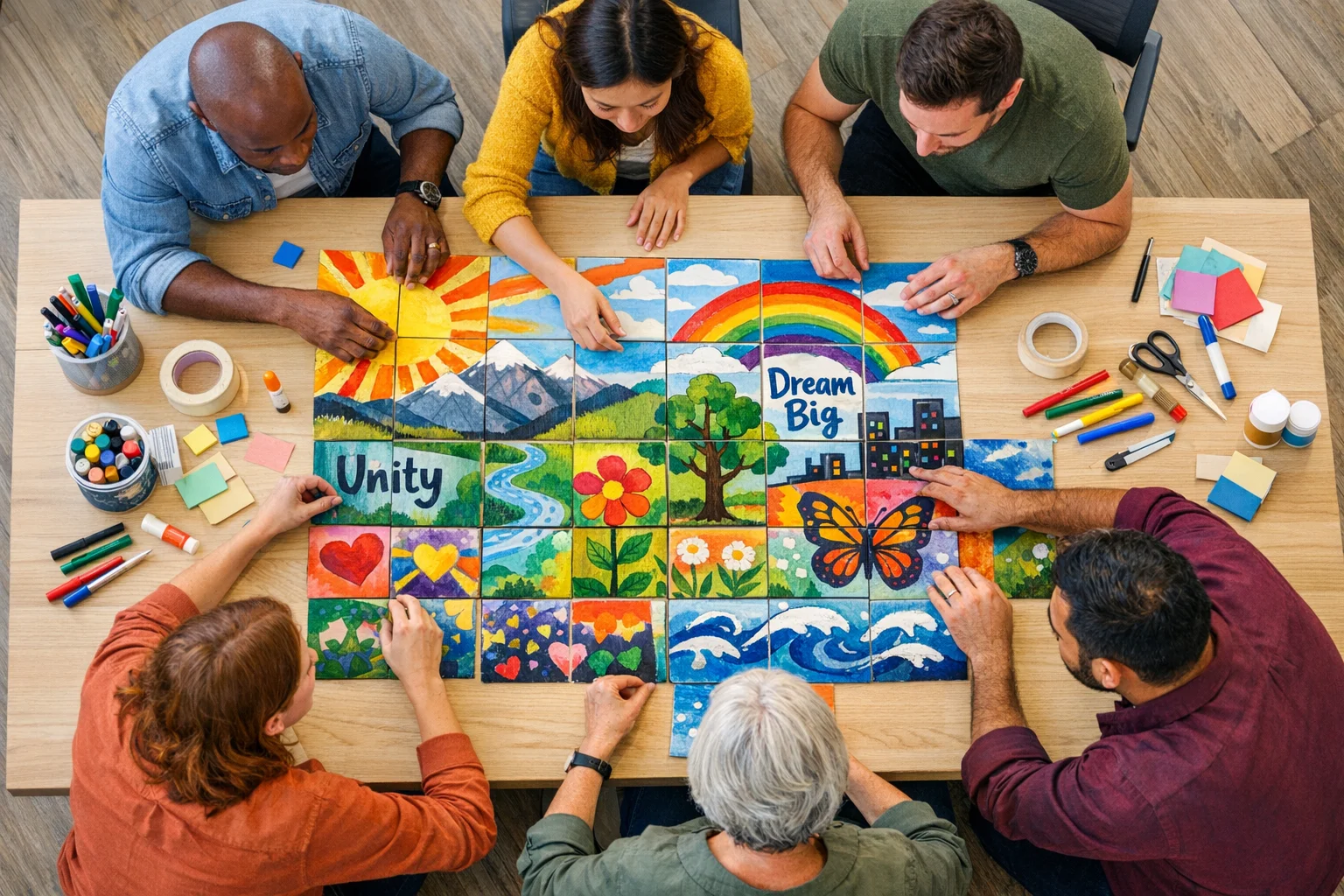
Why it works: Individuals create small tiles that assemble into one mural. Personal expression plus collective artifact equals instant ownership.
Setup: Provide square cards or canvas panels, markers/paint, and a loose theme (values, customers, “our year ahead”).
How to run: People design tiles solo or in pairs, then assemble into a single mural. Do a quick gallery walk and have volunteers narrate unexpected connections.
Remote twist: Mail mini tiles or use a shared design board (Canva, Mural) with pre-sized squares; print and mount later.
Debrief prompts: What patterns emerged unplanned? Where did we coordinate vs improvise?
Why it works: Building with humble materials levels status and forces quick iteration.
Setup: Boxes, tape, paper, markers, and a shared “city brief” (transit, parks, accessibility).
How to run: Small teams build districts that must connect physically on a floor map. Midway, introduce a constraint (new river, zoning change) so teams renegotiate.
Remote twist: Use paper architecture or a simple 3D tool; stitch screenshots into one panorama.
Scavify prompts:
Debrief prompts: How did we handle surprise constraints? Who bridged across teams?
Why it works: Turning “junk” into form trains resourcefulness and reframing.
Setup: Retired swag, binder clips, scrap cardboard, string, rubber bands, and one tool per team.
How to run: Give a theme (“delight a new hire,” “reduce steps for customers”). Require at least one moving part.
Remote twist: Ask each person to bring three household items to repurpose. Vote on most ingenious mechanism.
Debrief prompts: Where did constraints help vs hinder? What did we learn about handoffs?
Why it works: Symbols make values concrete. Designing one forces decisions about identity.
Setup: Fabric rectangles or paper, tape/paint, and a simple heraldry template (color, symbol, motto).
How to run: Each team drafts, critiques, and finalizes a flag, then explains choices in one minute.
Remote twist: Design digitally, then print for the workspace.
Debrief prompts: Which choices were easy vs contested? How will we use this symbol so it stays alive?
Why it works: Turning a workflow into a playable board game exposes bottlenecks and hidden rules.
Setup: Blank boards, markers, index cards, dice/spinners, and stickers for tokens.
How to run: Teams pick a real process, design movement rules, and write event cards (“vendor delay,” “customer surprise”). Quick cross-play between teams to test.
Remote twist: Build with an online whiteboard and run playtests in breakout rooms.
Debrief prompts: What rules created friction? Which mechanics felt like our real work?
Why it works: Personal stories stitched into a single artifact build empathy without forced vulnerability.
Setup: Paper or fabric squares and prompts (family recipe, first job, proudest team win). Provide connectors or a grid.
How to run: People illustrate a square from a chosen prompt. Assemble into one quilt and hang it in a visible space.
Remote twist: Collect digital squares and print as a poster.
Debrief prompts: What did you learn you wouldn’t have in a normal meeting?
Why it works: Sequence thinking, interfaces between teams, and joyful failure all in one.
Setup: Dominoes, ramps, balls, tape, cups, string. Each team owns a segment with an input and output spec.
How to run: Build segments separately, then connect and refine. Celebrate partial runs as wins.
Remote twist: Teams pre-record segments at home; stitch clips into one satisfying chain.
Debrief prompts: Which interfaces caused rework? How did we test assumptions early?
Why it works: Simple, tactile making with visible progress is calming and social. Plants also bring a bit of ongoing care to desks.
Setup: Jars, pebbles, soil, small succulents or air plants, and decorative bits.
How to run: Set up stations. Teams design a “brand” style for their terrariums and explain care tips to the group.
Remote twist: Ship kits; do a live build. People post photos over time to show growth and survival.
Debrief prompts: Where did we standardize vs personalize? How will we maintain what we made?
Why it works: Exposes assumptions and communication patterns. Half the fun is discovering the missing pieces are social, not physical.
Setup: Simple build kits with the instructions removed and replaced by a “contact the other team for one hint” rule.
How to run: Teams attempt the build, decide when to use their hint, and document the moment they realized what was missing.
Remote twist: Use printable papercraft. Share only the final silhouette and a cryptic title.
Debrief prompts: What did we try before asking for help? How do we request help at work?
Why it works: Visual storytelling surfaces blind spots. Collage reduces perfection pressure.
Setup: Magazines, printouts, markers, sticky notes. Provide a start-to-finish customer path.
How to run: Teams illustrate the journey, annotate emotional highs/lows, and star the “one moment that matters.”
Remote twist: Build in a shared slide deck; one team per stage.
Debrief prompts: Where do we create delight vs debt? What change would remove the most friction?
Why it works: Short sprints with odd materials train adaptive problem solving.
Setup: Rotate materials every few minutes (straws, string, paper, clay). New brief each round.
How to run: Three rounds: stability, height, movement. Celebrate clever failures out loud.
Remote twist: Home materials only. Spotlight the most inventive use.
Debrief prompts: What changed between rounds? Who tried something that unlocked progress?
Why it works: Shared narratives without presentation fear. The artifact becomes a lightweight prompt later.
Setup: Smooth stones or tiles, paint pens, and a prompt set (team wins, customer quotes, principles).
How to run: Individuals draw one symbol per prompt. Arrange stones to tell a team story in 60 seconds.
Remote twist: Use digital icons; assemble on a shared canvas.
Debrief prompts: Which symbols resonated? What story do we want to create this quarter?
Why it works: Classic build exercise with a craft spin that rewards prototyping. Tom Wujec’s Marshmallow Challenge famously shows that iterative builders beat planners who delay tests. Add creative constraints to freshen it. (tomwujec.com)
Setup: Spaghetti, tape, string, one marshmallow, plus a decorative brief (“must include a team logo flag”).
How to run: Require at least three live tests before the final reveal. Bonus points for elegant reinforcement, not just height.
Remote twist: Paper-only towers on camera; measure with a household ruler.
Debrief prompts: When did we test? What did the first collapse teach us?
Keep it light but real.
If you want a recurring cadence, designate a short, repeatable ritual (first Thursday, 20 minutes, one mini-make). HBR’s take on rituals is simple: small, consistent acts compound belonging. (Hidden Power of Workplace Rituals). (hbr.org)
Cardboard, paper, tape, string, markers, and recycled office supplies cover 90 percent of activities. Add a few connectors (binder clips, rubber bands) and you’re set.
Short is better. Most of these fit comfortably into a brief working session. The key is a clear brief, visible reveal, and a focused debrief.
Give clear roles beyond “artistic” ones (tester, facilitator, storyteller). Use low-skill, high-ceiling materials and allow prototypes instead of polished outputs.
Yes. Mail simple kits or rely on household items. Pair physical builds with digital galleries and quick video demos. Keep instructions inside the app to avoid juggling links.
Tie the brief to real customers, processes, or values. In the debrief, ask one question about collaboration, one about learning, and one about next-step application.
Timebox quiet sketching up front, assign roles, and require multiple idea tests. These structure choices create room for more voices.
Run a single-round materials lab, story stones with one prompt, or a micro-collage on the customer’s “moment that matters.” End with one fast share-out.
Install the artifact (mural, flag, quilt) where it’s seen, schedule a tiny monthly make, and reference language from the reveal in team rituals. Consistency is the force multiplier.