Solutions
Your first hunt, live this afternoon.
Free to start · No download for participants
Apply gamification best practices that improve motivation, retention, and behavior change without overusing rewards, pressure, or empty competition.
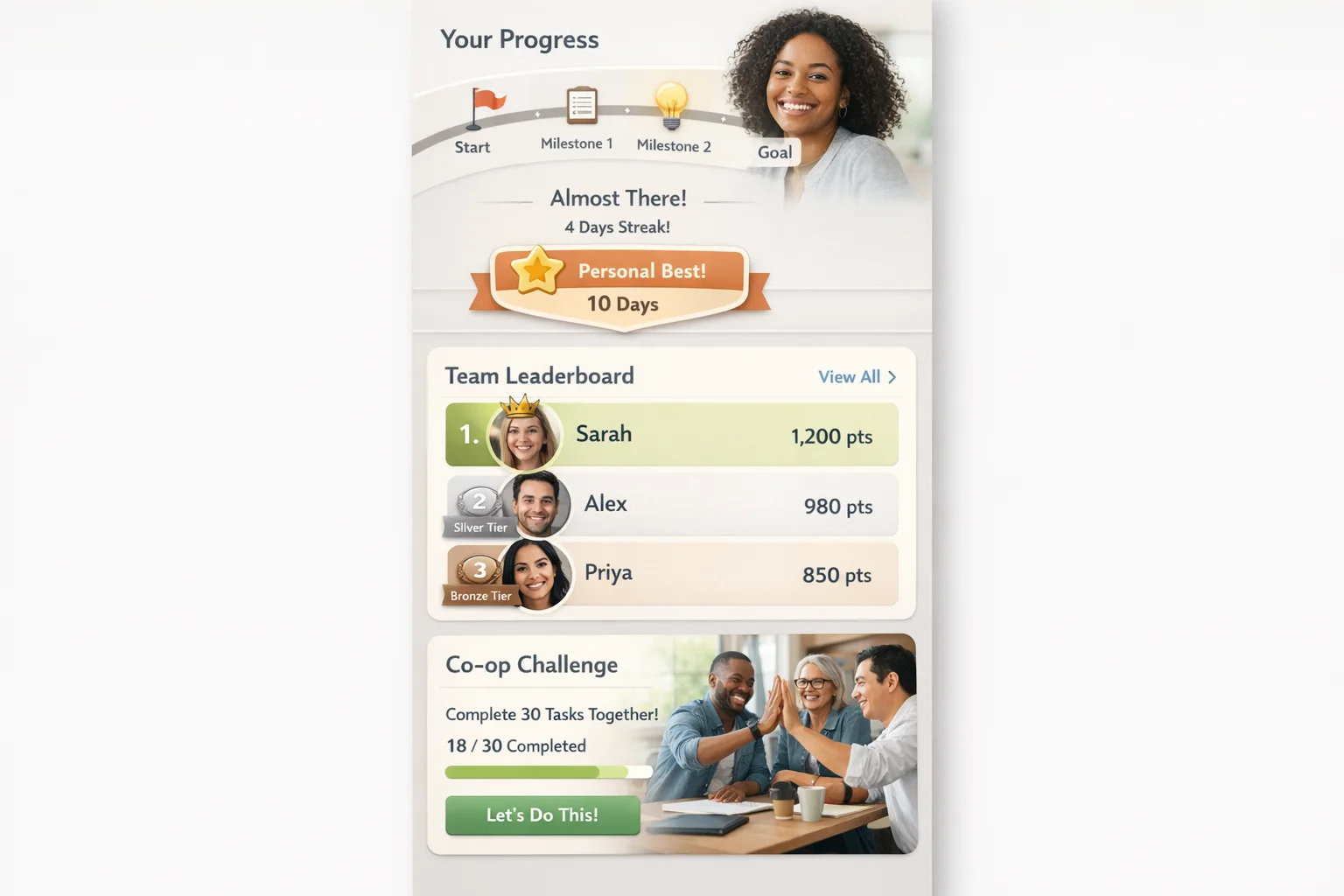
Most gamification efforts don’t fail because the idea is bad. They fail because the design confuses activity with motivation. Sprinkle in points and a leaderboard, hope for the best, then watch interest decay by week three. The fix is straightforward: design for human motivation first, then layer the right mechanics, pacing, and measurement.
Before we get tactical, level-set on terms. Gamification is the use of game design elements in non-game contexts. That definition matters because the elements only work when they support a real task, goal, or behavior in the real world. They’re seasoning, not the meal. From Game Design Elements to Gamefulness remains the clean, commonly cited definition. (creativegames.org.uk)
Done well, gamification can lift engagement and related outcomes. Reviews across online programs and education show positive, though context-sensitive, effects. The nuance: what you design and how you deliver it matters far more than whether you add “badges.” A PLOS ONE systematic review and a later meta-analysis in education both found overall positive effects with important moderators. (journals.plos.org)
Gartner’s oft-quoted prediction back in 2012 that “80% of gamified apps will fail” was less doom and more diagnosis: most attempts fixate on mechanics instead of meaningful goals and motivations. The warning still holds as an antidote to shallow design. (techcrunch.com)
Why it matters. Behavior happens when motivation, ability, and a prompt converge in the same moment. If a task is hard, motivation must be high or the prompt perfectly timed. If ability is high, a gentle nudge may be enough. This is the Fogg Behavior Model in one line: B = MAP. BJ Fogg’s model is a dependable starting grid. (behaviormodel.org)
How to do it. - Identify the single, observable action you want more of. Write it like a camera would see it. - Map friction. What makes that action difficult today? Reduce ability hurdles before adding incentives. - Place prompts at natural moments, not noisy ones. Tie them to context, not the calendar.
Watch for. Prompts that fire when ability is low create frustration. Mechanics can’t rescue a bad moment.
Why it matters. Self-Determination Theory (SDT) says people thrive when three basic needs are supported: autonomy (meaningful choice), competence (a sense of progress/mastery), and relatedness (belonging). Gamification sticks when mechanics reinforce these needs rather than replace them. The SDT community’s own overview is a useful reference. (selfdeterminationtheory.org)
How to do it. - Autonomy: Offer challenge paths or “choose-your-next-step” quests. - Competence: Calibrate difficulty and provide immediate, specific feedback. - Relatedness: Use cooperative goals and small-group recognition more than public shaming.
Watch for. If your mechanics make people feel controlled, you’ll crowd out intrinsic motivation. That’s not opinion; it’s well-replicated. (selfdeterminationtheory.org)
Why it matters. Decades of research show extrinsic rewards can undermine intrinsic motivation when they feel controlling, especially for tasks people already find interesting. The famous meta-analysis by Deci, Koestner, and Ryan (1999) remains the canonical summary. Use rewards to acknowledge competence and progress, not to coerce action. (selfdeterminationtheory.org)
How to do it. - Prefer earned status and meaningful unlocks over generic currency. - Make rewards informational (“you’ve mastered X”) instead of controlling (“do X or else”). - Tie any tangible rewards to milestones that reflect learning, contribution, or verified behavior change.
Watch for. Overjustification creeps in fast when people start playing the reward instead of the game. If you see “reward-chasing” behaviors that miss the spirit of the task, pivot. (selfdeterminationtheory.org)
Why it matters. People stay engaged when they can see meaningful progress. Teresa Amabile’s work on the “progress principle” shows that small wins have an outsized effect on day-to-day motivation and momentum. Build interfaces that surface those wins clearly and often. (hbr.org)
How to do it. - Replace vague “points” with named milestones that say what improved. - Use progress bars that track toward concrete outcomes, not endless ladders. - Add grace days for streaks to avoid loss-aversion spirals when someone misses once for legitimate reasons.
Watch for. Progress indicators that reset too often feel like a treadmill. Tie resets to seasons or narratives, not to arbitrary dates.
Why it matters. Leaderboards can motivate or demoralize depending on design and context. Experiments show leaderboards can lift quantitative performance by creating clear reference goals, but mixed results and elevated stress also appear in the literature. The pattern: competition helps when it’s proximal, fair, and adaptive; it hurts when it’s distant and permanent. (sciencedirect.com)
How to do it. - Use tiers, divisions, or pods so people compete with comparable peers, not superstars. - Display personal bests and streaks alongside ranks to create multiple ways to “win.” - Rotate or season the board so newcomers aren’t permanently buried. - Make global boards opt-in; default to team or cohort views.
Watch for. Relative feedback can widen disparities: top performers invest more, others disengage. If the tail drops when the head rises, refactor the board or switch to cooperative goals. (lish.harvard.edu)
Why it matters. People don’t respond to the same mechanics. Research on the HEXAD user types provides a practical way to think about differing preferences for social connection, mastery, creativity, rewards, purpose, and disruption. Personalization tends to outperform one-size-fits-all designs. (rinawehbe.ca)
How to do it. - Offer parallel paths (e.g., creative build, mastery challenge, social quest) and let people gravitate. - Use onboarding questions to steer starting challenges, then adapt to observed behavior. - Keep the mix varied so each type sees “their kind” of win regularly.
Watch for. Don’t overfit to a static test. Preferences evolve; let your system re-learn over time. (sciencedirect.com)
Why it matters. Engagement often spikes with novelty, then softens as patterns feel familiar. Rotating challenge types, themes, and difficulty bands keeps the experience from flattening into routine. Evidence from classroom quizzing platforms shows meaningful bumps in concentration, enjoyment, and motivation when the format itself is lively and varied. (sciencedirect.com)
How to do it. - Run in seasons with clear arcs and resets. - Rotate challenge formats weekly: skill, knowledge, creativity, collaboration, reflection. - Introduce limited-time quests and theme weeks to create fresh entry points without bloating the system.
Watch for. Constant novelty becomes noise. Pick a cadence and stick to it so people can anticipate, not guess.
Why it matters. You can create engagement without creating compulsion. Ethical design respects attention, provides clear opt-outs, and avoids punishing people for being offline. A useful north star: design for “time well spent,” not time spent. The Center for Humane Technology articulates the risks of manipulative loops and the value of healthier defaults. (humanetech.com)
How to do it. - Give people notification control and quiet hours by default. - Make streaks humane: add skip tokens or rest days. - Keep probabilistic rewards rare and transparent; avoid casino-style loops in work or learning contexts. - Publish your principles upfront so teams hold each other accountable.
Watch for. If a mechanic works mainly because people fear losing status, it’s probably extracting, not engaging.
Why it matters. Gamification should move real metrics: completion, quality, attendance, retention, NPS, safety behaviors, knowledge checks that predict performance. Treat every mechanic like a hypothesis and test it with the same rigor you’d apply to a product feature.
How to do it. - Define primary outcomes (what must go up) and guardrails (what must not go down: quality, satisfaction). - Precompute sample size and run the full test window. Tools like Evan Miller’s sample size calculator are simple and reliable. (evanmiller.org) - Decide upfront how long to run and when to stop. Optimizely’s guidance on test duration is a practical reference for timing and interpretation. (support.optimizely.com) - Instrument behavior at the moment level (prompt seen, prompt acted, time-to-complete), not just weekly rollups.
Watch for. Peeking at results and stopping early creates mirages. If you must stop for harm, document it and learn.
A pattern we keep seeing: variety beats volume. Mix formats so different motivation profiles get to shine. In Scavify, we often structure rotations that touch mastery, creativity, cooperation, and exploration in one week. Challenge prompts below are written as mini-mysteries on purpose; they set a target without scripting the path.
Scavify’s challenge variety, automation, and app-plus-browser flexibility make rotations like these easy to run at scale without turning your team into full-time game masters. The goal stays the same: make passive participation active.
Anchor to a single behavior, design for autonomy/competence/relatedness, and make progress unmistakably visible. Mechanics come after that. A simple MAP check (motivation–ability–prompt) keeps you honest on whether the moment is right. (behaviormodel.org)
Sometimes. They can raise quantitative performance by giving people a salient target, but they can also increase stress and widen disparities. Use divisions, personal bests, and fresh seasons; avoid permanent, global boards as the default. (sciencedirect.com)
Keep them informational, not controlling. Recognize mastery, progress, and contribution rather than paying for mere clicks. The 1999 meta-analysis on rewards and intrinsic motivation is your caution sign. (selfdeterminationtheory.org)
Leading indicators like task start rate, prompt-to-action conversion, and time-to-complete, plus lagging outcomes like retention, quality, or performance on validated checks. Predefine guardrails so you don’t win at the expense of satisfaction or quality.
Rotate formats and themes on a predictable cadence. Too little novelty and people glaze over; too much and it’s noise. Evidence from lively quiz formats shows meaningful bumps when the experience itself changes thoughtfully. (sciencedirect.com)
Use SDT for first principles (autonomy, competence, relatedness), Octalysis as a lens on diverse drives, and HEXAD for practical personalization. You don’t need a single religion; pick the pieces that help your context. (selfdeterminationtheory.org)
Long enough to hit your precomputed sample size and capture natural cycles in behavior. Don’t stop on a Friday pop. Use a simple calculator to plan and follow timing guidance from reputable experimentation resources. (evanmiller.org)
It can work long-term when mechanics evolve with the audience and when progress remains meaningful. Static designs ride novelty up and then coast down. Fresh seasons, adaptive difficulty, and varied goals extend the curve. Evidence shows overall positive effects when design and context align. (pubmed.ncbi.nlm.nih.gov)
Design for what people actually need to do, make progress obvious, and keep things human. Do that, and you won’t need to shout to keep participation high; the experience will do the heavy lifting on its own.